← Year 4 religious education worksheets

Year 4 Prophet Muhammad ﷺ: how does he inspire Muslims today? worksheet

“Early life in Arabia” is free to print, with no account. It is the first sheet in the Year 4 religious education unit “Prophet Muhammad ﷺ: how does he inspire Muslims today?”, for children aged 8 to 9, and takes about 20 minutes.

Print it on A4. The child's pages come first; the answers, and what each wrong answer tells you, are on the grown-up page that follows. Weeks 19 to 24 of the year, 6 sheets in the unit.

Free sample · answers on the last page

Early life in Arabia

Name: ____________ · Date: ____________
Year 4 · Religious education · about 20 minutes
Answers are on the grown-up page

Today I can describe the beliefs in Arabia when Muhammad ﷺ was born and how his early life shaped him.

A Look back3 min

  1. 1.

    Which symbol on this map is a place where Christians go to pray? Circle one.

    ABC123SN
    churchschoolshop
  2. 2.

    Join each symbol to what it is used for.

    ABC123N
    churchhouse
    people live hereChristians pray here
  3. 3.

    Stand facing north. Which direction is on your right? Circle one.

    NNESESSWWNW
    EastWestSouth

B Watch me, then you5 min

Muhammad ﷺ was born in Makkah in 570 CE. His mother died when he was six. How might this have shaped him?

Watch me
AD 560AD 565AD 570AD 575AD 580Muhammad ﷺ bornMother died

Muhammad ﷺ lost his father before he was born, and his mother when he was six.

He knew how it feels to be an orphan.

Muslims believe this is one reason he cared so much for orphans.

Now you
  1. 1.

    After his grandfather died, his uncle Abu Talib looked after Muhammad ﷺ. How might being taken in by family have shaped him?

    AD 570AD 575AD 580BornMother diedGrandad died

C Your turn6 min

In 570 CE, Arabia had many beliefs. Polytheists worshipped many gods and idols. Hanifs believed in one God but were not Jewish or Christian. Jewish and Christian communities lived there too.
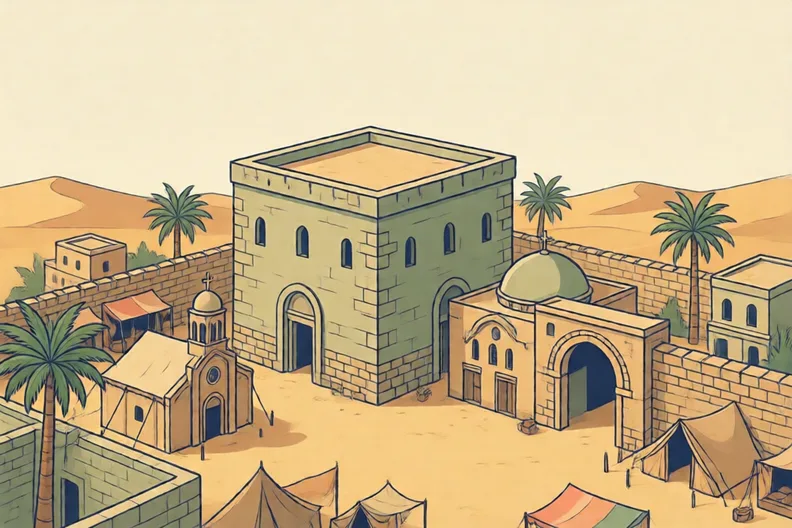
A dry desert city with a cube-shaped stone building, a small church and a synagogue, no people
  1. 1.

    Which group in Arabia believed in many gods? Circle one.

    PolytheistsHanifsChristians
  2. 2.

    Which group believed in one God but did not follow Judaism or Christianity? Circle one.

    PolytheistsHanifsJewish communities
  3. 3.

    Write each group in the right column.

    PolytheistsHanifsJewish communitiesChristian communities
    Believed in many godsBelieved in one God
  4. 4.

    Write one sentence. Why did Arabia not have just one religion in 570 CE?

Say it out loud: What changed from one question to the next? Tell your grown-up in your own words.

D Spot the mistake3 min
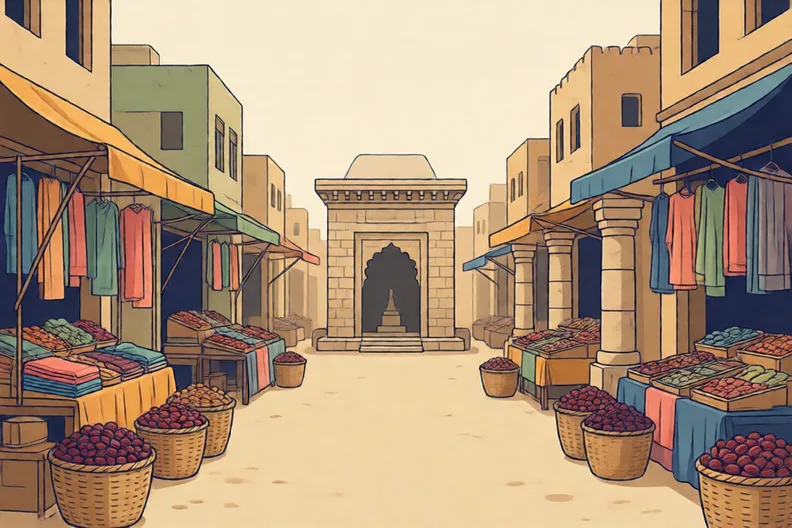
A market street with cloth stalls, baskets and a small stone shrine
Kit says: “In 570 CE, everyone in Arabia was Muslim.”
  1. 1.

    Is Kit right? Write why.

E Think deeper3 min
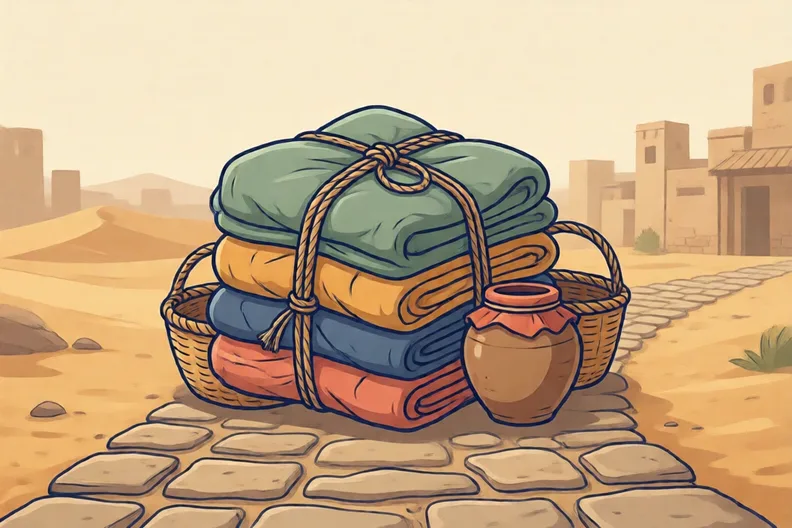
A heavy bundle of cloth and baskets on a stone path
  1. 1.

    A story tells how Muhammad ﷺ carried a heavy bundle for an old woman without being asked. Why does this show compassion? Use the word compassion.

How did it feel?

I can do it Nearly Not yet
StudyDen · Year 4 · Religious education · Prophet Muhammad ﷺ: how does he inspire Muslims today?Answers are on the grown-up page

For the grown-up

Early life in Arabia · 2 minutes to read

Answers, and what a wrong one tells you

A

1. church They may have picked the school because it is also a building. Ask: where do Christians go to worship?

2. church → Christians pray here; house → people live here If the church is joined to the house, ask them what people do inside a church and what people do inside a home.

3. East If they chose West, they may have turned to the left. Ask them to turn so that their right arm points out.

B

1. Look for: Gives a sensible way being cared for by family could shape someone, such as learning gratitude or caring for others who are alone. If your child only retells the dates, ask how Muhammad ﷺ might feel about other children with no parents.

C

1. Polytheists Hanifs believed in one God. Ask: which group worshipped many gods and idols?

2. Hanifs If they chose Jewish communities, ask: what did Jewish people believe, and what made the Hanifs different from them?

3. Believed in one God: Hanifs, Jewish communities, Christian communities · Believed in many gods: Polytheists

4. Look for: Names at least two of: polytheists, Jewish communities, Christian communities, Hanifs, and says they lived side by side.

D

1. Look for: Says Kit is wrong, because Islam had not yet begun in 570 CE, and names another group such as polytheists, Jewish or Christian communities or Hanifs. If they say Kit is right, read the Your turn box again. Ask which groups lived in Arabia in 570 CE.

E

1. Look for: Explains that noticing someone struggling and helping them without being asked shows compassion, using the word compassion.

Words to use

Say“Where was Muhammad ﷺ born, and what other beliefs were around him then?”
Instead of“Tell them the answer straight away, before they have looked at the pictures.”

After the sheet

Look at an old family photo together. Talk about one thing that happened when you were young and how it shaped who you are now.

Tick what your child got right in StudyDen. Anything missed comes back in a later Look back box, so there's no need to redo the sheet.

The rest of this unit

5 more sheets come with a StudyDen plan, in teaching order:

  1. Early life of Muhammad ﷺ(with a plan)
  2. The Journey to Madinah(with a plan)
  3. The Prophet as a Leader(with a plan)
  4. Qur'an and Hadith(with a plan)
  5. Caring for the world(with a plan)

Every Year 4 religious education worksheet

The worksheets plan opens a printable sheet for every lesson in Years 1 to 6, each with its answers on a separate page for you. It costs £6.99 a month or £59 a year for the whole family, with no free trial.

The full StudyDen plan adds the lessons themselves, marked as your child works, with the worksheets included. It is 7 days free, then £29.99 a month.

Both start with a free account; you choose the plan when you sign up.