← Year 5 religious education worksheets

Year 5 Jews: how does remembering maintain Jewish identity? worksheet

“Many ways to celebrate” is free to print, with no account. It is the first sheet in the Year 5 religious education unit “Jews: how does remembering maintain Jewish identity?”, for children aged 9 to 10, and takes about 22 minutes.

Print it on A4. The child's pages come first; the answers, and what each wrong answer tells you, are on the grown-up page that follows. Weeks 1 to 6 of the year, 6 sheets in the unit.

Free sample · answers on the last page

Many ways to celebrate

Name: ____________ · Date: ____________
Year 5 · Religious education · about 22 minutes
Answers are on the grown-up page

Today I can explain how Jews celebrate Rosh Hashanah in different ways.

A Look back3 min

  1. 1.

    Which religion is the Torah the holy text of? Circle the answer.

    Torah scrollRead in asynagogue
    JudaismChristianitySikhism
  2. 2.

    Where do Christians usually go to worship? Circle the answer.

    Pews insideAltar atthe front
    churchmosquegurdwara
  3. 3.

    Which holy book do Muslims read? Circle the answer.

    Holy bookReadevery day
    Qur'anTorahBible

B Watch me, then you4 min

Many Jewish families dip apple in honey at Rosh Hashanah. Here is what that tradition means.

Watch me
Apple in honeySweet honeyShana Tovah

Many families dip apple in honey at Rosh Hashanah.

The sweet honey stands for a sweet new year.

Families say Shana Tovah, which means have a good year.

Now you
  1. 1.

    Round challah bread is baked in a circle. What does the round shape stand for? Circle the answer.

    ChallahRound loaf
    the cycle of life and the yeara loud partya day off school

C Your turn8 min

Each row is one Jewish tradition. Not every Jewish family keeps all of them, or keeps them in the same way.
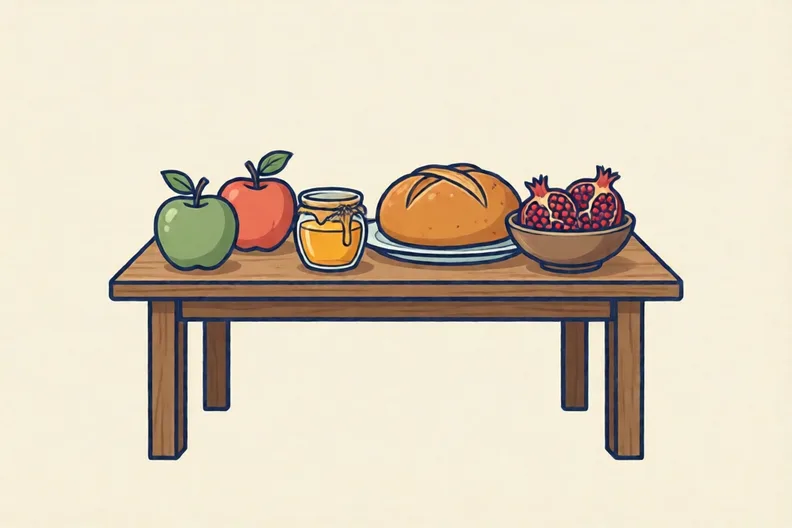
A table set with apples, a small dish of honey, a round loaf and a bowl of pomegranate seeds
  1. 1.

    Join each tradition to what it means.

    Apple dipped in honeyRound challahPomegranate seedsShana Tovah
    good deeds to comehave a good yeara sweet new yearthe cycle of life
  2. 2.

    Sort these traditions. Write each one in the right column.

    apple dipped in honeyShana Tovahchallahpomegranate seeds
    Food eatenWords said
  3. 3.

    Families do not all do this in the same order. In Leah's family, the blessing is said over apple already sticky with honey, and nobody eats before it. Number Leah's steps 1, 2, 3.

    1. Eat and wish each other Shana Tovah
    2. Dip the apple in honey
    3. Say the blessing over the apple and honey
  4. 4.

    A pomegranate has many seeds inside. What do the many seeds stand for? Circle the answer.

    PomegranateMany seeds
    good deedsfireworksrain

Say it out loud: Each tradition has a meaning. Did you find the meaning from the food or from the words?

D Spot the mistake3 min

Ruby says: “All Jews celebrate Rosh Hashanah in exactly the same way.”
Same festivalDifferent homesDifferent ways
  1. 1.

    Ruby is wrong. Write how two Jewish families might celebrate Rosh Hashanah in different ways.

E Think deeper4 min

A table set with apples, a small dish of honey, a round loaf and a bowl of pomegranate seeds
  1. 1.

    Why can a festival be personal and shared at the same time? Give one example and tell your grown-up.

How did it feel?

I can do it Nearly Not yet
StudyDen · Year 5 · Religious education · Jews: how does remembering maintain Jewish identity?Answers are on the grown-up page

For the grown-up

Many ways to celebrate · 2 minutes to read

Answers, and what a wrong one tells you

A

1. Judaism If your child chooses Christianity, remind them that Christians use the Bible. The Torah belongs to Judaism, and it is read in synagogues.

2. church

3. Qur'an

B

1. the cycle of life and the year If your child chooses a loud party, ask what a round shape reminds Jews of. Point to the picture: the loaf is round, and the round shape is about life and the year.

C

1. Apple dipped in honey → a sweet new year; Round challah → the cycle of life; Pomegranate seeds → good deeds to come; Shana Tovah → have a good year If your child joins the apple to the cycle of life, ask which food is dipped in honey. Then ask what the sweet honey is meant to show.

2. Food eaten: apple dipped in honey, challah, pomegranate seeds · Words said: Shana Tovah

3. 1 Dip the apple in honey · 2 Say the blessing over the apple and honey · 3 Eat and wish each other Shana Tovah

4. good deeds If your child chooses fireworks, ask what Jews hope to do many of in the new year. Look back at the line they drew from Pomegranate seeds.

D

1. Look for: A good answer names two different ways, such as praying at a synagogue and baking challah at home, and shows the claim is false. If your child just repeats Ruby, point to the chain. Ask: could one family keep a tradition that another family does not?

E

1. Look for: A good answer says families keep different traditions but share the same hope for a good year, such as the greeting Shana Tovah.

Words to use

Say“What does this food or greeting stand for? Could another family have a different way to mark the same day?”
Instead of“Tell them the one right way Jews celebrate, so they can copy it.”

After the sheet

At tea time, ask your child how your family marks the start of a new week or term. Then talk about why two families might do it in different ways.

Tick what your child got right in StudyDen. Anything missed comes back in a later Look back box, so there's no need to redo the sheet.

The rest of this unit

5 more sheets come with a StudyDen plan, in teaching order:

  1. Rosh Hashanah and Yom Kippur(with a plan)
  2. Esther and Haman's plot(with a plan)
  3. How Jews Mark Purim(with a plan)
  4. Eight nights of light(with a plan)
  5. Hanukkah traditions and identity(with a plan)

Every Year 5 religious education worksheet

The worksheets plan opens a printable sheet for every lesson in Years 1 to 6, each with its answers on a separate page for you. It costs £6.99 a month or £59 a year for the whole family, with no free trial.

The full StudyDen plan adds the lessons themselves, marked as your child works, with the worksheets included. It is 7 days free, then £29.99 a month.

Both start with a free account; you choose the plan when you sign up.