Roman Christians in Britain
Today I can explain what Roman objects can and cannot tell us about Christianity in Britain.
A Look back3 min
- 1.
Number these in order, earliest first.
- Romans leave Britain (about 410 CE)
- Romans invade Britain (43 CE)
- Hadrian's Wall is started (122 CE)
- 2.
The Romans invaded Britain in 43 CE. Hadrian's Wall was started in 122 CE. How many years is that from 43 to 122?
- 3.
Write < or > in the box: 122 410
B Watch me, then you4 min
In a made-up town, a wall painting dated 350 CE shows a cross. What can we say for certain about when Christians lived there?
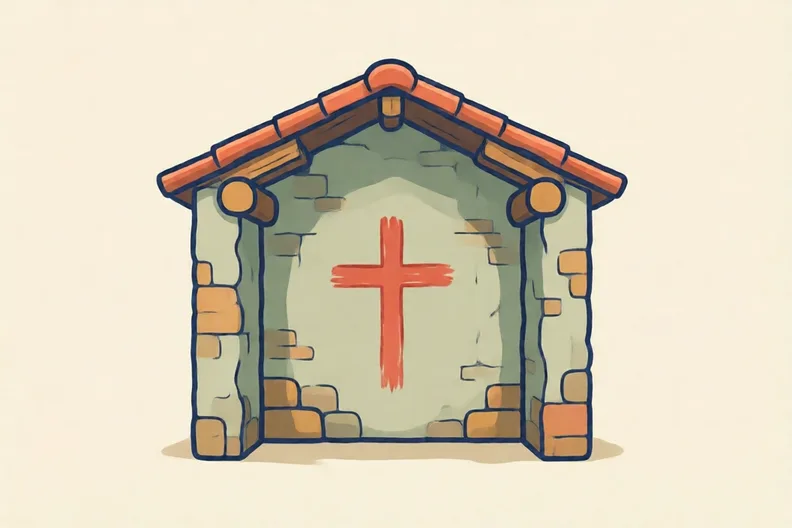
The painting was made in 350 CE. That is the earliest date we can prove.
Christians may have lived in the town before 350 CE.
So the painting shows when Christians were visible, not when they first came.
- 1.
In a made-up village, a carved stone dated 380 CE shows a cross. Which can we say for certain?
Christians lived there only in 380 CE.Christians may have lived there before 380 CE.Christians first arrived there in 380 CE.
C Your turn8 min
Work out the gap between each pair of dates. Then answer the last question.
- 1.
Around 200 CE, a writer called Tertullian said there were Christians in Britain. The Hinton St Mary mosaic was made about 350 CE. How many years apart are these?
- 2.
In 314 CE, three bishops from Britain went to a church meeting in Arles, in France. The Hinton St Mary mosaic was made about 350 CE. How many years apart are these?
- 3.
The Romans invaded Britain in 43 CE. They left about 410 CE. How many years was that?
- 4.
A Roman villa chapel in Britain has wall paintings from the 300s CE. Which statement is true?
Christianity may have arrived before the 300s CE.Christianity must have arrived in Britain in the 300s CE.
Say it out loud: What did you do each time to find the gap? What do the first two gaps tell you about Christians in Britain before the mosaic?
D Spot the mistake3 min
- 1.
Explain in one or two sentences why Kit is wrong.
E Think deeper4 min
- 1.
Think of one Roman object, such as a pot or a stone. What can it prove about belief in Britain, and what can it not prove?