← Year 5 art worksheets

Year 5 Abstract art: drawing, printing and textiles worksheet

“Exploring abstract art” is free to print, with no account. It is the first sheet in the Year 5 art unit “Abstract art: drawing, printing and textiles”, for children aged 9 to 10, and takes about 20 minutes.

Print it on A4. The child's pages come first; the answers, and what each wrong answer tells you, are on the grown-up page that follows. Weeks 21 to 26 of the year, 6 sheets in the unit.

Free sample · answers on the last page

Exploring abstract art

Name: ____________ · Date: ____________
Year 5 · Art & design · about 20 minutes
Answers are on the grown-up page

Today I can explain how abstract art shows feelings instead of copying what things look like.

A Look back3 min

  1. 1.

    Which pair of paints makes green? Circle one.

    redyellowblue
    red and yellowblue and yellowred and blue
  2. 2.

    Which of these three colours is the lightest? Circle one.

    whitegreyblack
  3. 3.

    Join each colour to the kind of colour it is.

    redorange
    redorange
    a secondary coloura primary colour

B Watch me, then you4 min

Ola wants her abstract painting to feel calm after a walk by the sea. Which colours could help her?

Watch me
bluewhite

Ola wants a calm feeling.

Bright red feels loud, so it does not fit.

Pale blue and soft white feel quiet and gentle.

Now you
  1. 1.

    Ben wants his painting to feel angry. Circle the colour that fits best.

    blueredgreen
    pale bluebright redsoft green

C Your turn6 min

Abstract art can use colour to show a feeling instead of copying. Read each question, then circle the colour that fits.

  1. 1.

    A real lime is green. Fay paints an abstract lime to show that she feels hot and excited. Circle the colour that shows this feeling best.

    orangegreenpurple
    orangegreenpurple
  2. 2.

    Fay paints a summer leaf as a copy of how it really looks, so this painting is not abstract. Circle the colour she uses.

    greenorange
    orangegreenpurple
  3. 3.

    Fay paints an abstract tree that feels strange and dreamy. Circle the colour that looks least like a real tree's leaves.

    purpleorange
    orangegreenpurple
  4. 4.

    Fay's abstract painting uses bright red and feels too angry. She adds white to make it feel gentler. Circle the colour she gets.

    redwhite
    pinkgreenpurple

Say it out loud: Which question asked you to copy, and which asked you to show a feeling? How could you tell?

D Spot the mistake3 min

Kit says: “Abstract art has to copy what things really look like, so grass can only be green.”
greenpurpleorange
  1. 1.

    Kit is wrong. Abstract grass can show a feeling instead. Circle the colours that would not copy real grass.

    greenpurpleorange

E Think deeper4 min

Look at the objects in the picture. Then do the activity.
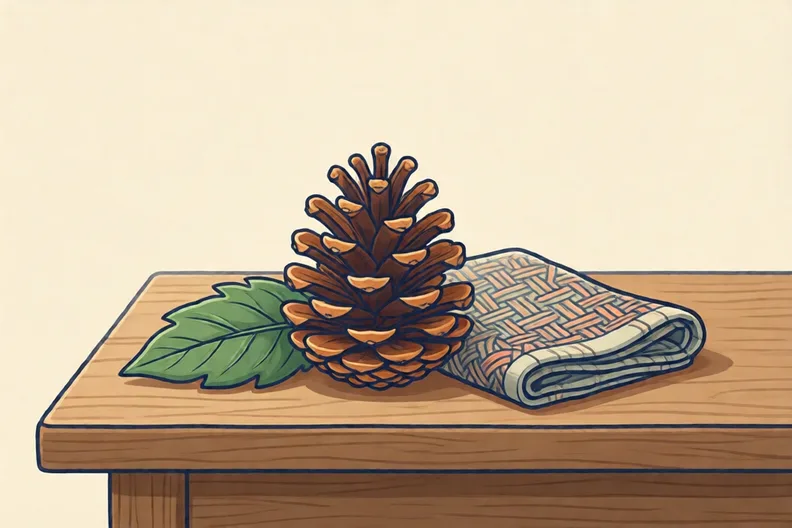
A pinecone, a green leaf and a folded cloth on a table
  1. 1.

    Pick one object from the picture or from home with an interesting texture or shape. Draw an abstract response, not an exact copy. Then write what the object is and the emotion you tried to show.

How did it feel?

Think about today. Did abstract art feel like a shortcut or a challenge? Tell your grown-up one sentence about why.

I can do it Nearly Not yet
StudyDen · Year 5 · Art & design · Abstract art: drawing, printing and textilesAnswers are on the grown-up page

For the grown-up

Exploring abstract art · 2 minutes to read

Answers, and what a wrong one tells you

A

1. blue and yellow If your child circles red and yellow, that pair makes orange. Ask your child to say the colour each pair makes, then try one mix on scrap paper.

2. white If your child circles black, that is the darkest colour. Ask your child to point to the lightest swatch first, then the darkest.

3. red → a primary colour; orange → a secondary colour

B

1. bright red If your child circles pale blue, that colour feels cool and calm, not angry. Ask your child which colour feels loudest and strongest.

C

1. orange If your child circles green, that copies a real lime. Ask which colour feels hottest, then look at the orange swatch together.

2. green If your child circles orange or purple, ask what colour a leaf really is in summer. A copy matches how the thing really looks.

3. purple If your child circles green or orange, ask whether real leaves can be that colour in summer or autumn. Purple looks least like a real tree, so it feels strange.

4. pink If your child circles purple, they are thinking of red and blue. Adding white to red makes pink, a softer and gentler colour.

D

1. purple, orange If your child circles green, ask whether green copies real grass. Abstract art can use any colour to show a feeling.

E

1. Look for: A named object, abstract shapes or marks that are not an exact copy, and one emotion in a sentence.

Words to use

Say“Which feeling did you want your picture to show, and which colours would help?”
Instead of“Abstract art is easy, so just scribble and it will be fine.”

After the sheet

Lay out three household objects, such as a spoon, a leaf and a sock. Draw each one as shapes and lines, not an exact copy, then ask: what feeling does each drawing give?

Tick what your child got right in StudyDen. Anything missed comes back in a later Look back box, so there's no need to redo the sheet.

The rest of this unit

5 more sheets come with a StudyDen plan, in teaching order:

  1. Build a Mark-Making Toolkit(with a plan)
  2. Make an abstract composition(with a plan)
  3. Printing with paper-cut shapes(with a plan)
  4. Plan a Stitched Panel(with a plan)
  5. Stitches on Felt(with a plan)

Every Year 5 art worksheet

The worksheets plan opens a printable sheet for every lesson in Years 1 to 6, each with its answers on a separate page for you. It costs £6.99 a month or £59 a year for the whole family, with no free trial.

The full StudyDen plan adds the lessons themselves, marked as your child works, with the worksheets included. It is 7 days free, then £29.99 a month.

Both start with a free account; you choose the plan when you sign up.