← Year 5 art worksheets

Year 5 Photography and painting: facial expressions in portraiture worksheet

“Photo series of facial expressions” is free to print, with no account. It is the first sheet in the Year 5 art unit “Photography and painting: facial expressions in portraiture”, for children aged 9 to 10, and takes about 20 minutes.

Print it on A4. The child's pages come first; the answers, and what each wrong answer tells you, are on the grown-up page that follows. Weeks 4 to 8 of the year, 6 sheets in the unit.

Free sample · answers on the last page

Photo series of facial expressions

Name: ____________ · Date: ____________
Year 5 · Art & design · about 20 minutes
Answers are on the grown-up page

Today I can take a series of expression photos with sharp focus and good light.

A Look back3 min

  1. 1.

    Blue and yellow make which colour? Circle one.

    redyellowblue
    greenpurpleorangebrown
  2. 2.

    Which set of colours are primary colours? Circle one set.

    red, yellow, bluered, green, purpleorange, green, purple
  3. 3.

    Which word means how light or dark an area looks? Circle one.

    lightestdarkest
    tonetexturelineshape

B Watch me, then you4 min

Ali wants a photo of Bea looking surprised. The first shot is dark and blurry. Here is how Ali fixes it.

Watch me
lightestdarkest

The first shot sits near the dark end of the tones.

Bea turns to face the window, so light falls evenly on Bea's face.

Ali taps Bea's face to focus, so the new shot is sharp and the expression shows.

Now you
  1. 1.

    Ali's next shot is blurry. Circle the part of the screen Ali should tap before the shot.

    the facethe wall behindthe window glass
  2. 2.

    Bea's face is in shadow. Circle where Bea should stand.

    lightestdarkest
    facing the windowwith back to the windowin a dark corner

C Your turn6 min

Circle or sort. Each question is about light, focus or expression.
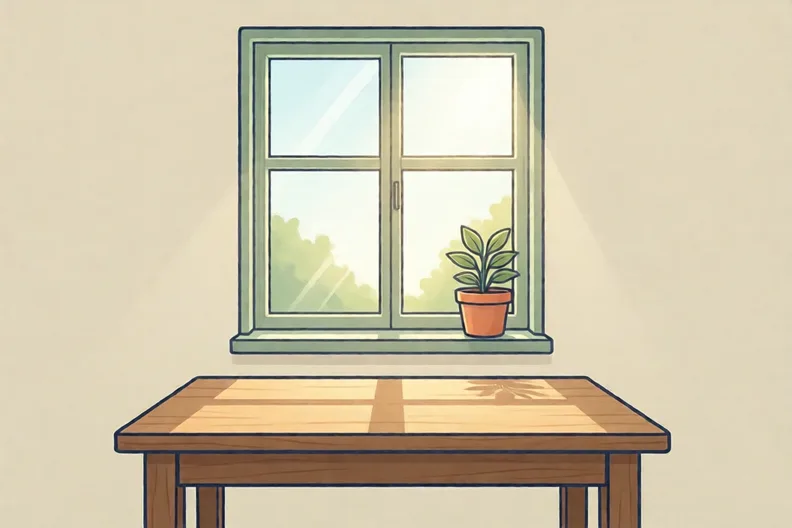
A plain kitchen window with soft daylight on a wooden table and a small pot plant
  1. 1.

    Which is the best place for lighting a face in a photo? Circle one.

    a window in daylighta dark cornerthe middle of a dark room
  2. 2.

    Which features show surprise most clearly? Circle one.

    raised eyebrows and wide open eyesdownturned lips and soft eyestight mouth and squinting eyes
  3. 3.

    Sort these into the two columns. Write each one in the right column.

    tap the face to focusstand with back to the windowface the windowa smudged lenstake at least three shots
    Helps the photoHurts the photo
  4. 4.

    Put these steps in the right order. Write 1 to 4 in the boxes.

    1. Review the shots and pick the best one
    2. Take at least three shots of one expression
    3. Set up near a window
    4. Tap the face to focus

Say it out loud: Which change to the set-up made the biggest difference to the photo, and why?

D Spot the mistake3 min

Kit says: “A face cannot show a feeling unless someone says the word for it.”
Raised eyebrowsWide open eyesOpen mouthSurprised face
  1. 1.

    Why is Kit wrong? Write one sentence.

E Think deeper3 min

lightestdarkest
  1. 1.

    Ali has two surprise photos. One is sharp but a little dark. One is bright but blurry. Which would you keep, and why? Write it below.

How did it feel?

I can do it Nearly Not yet
StudyDen · Year 5 · Art & design · Photography and painting: facial expressions in portraitureAnswers are on the grown-up page

For the grown-up

Photo series of facial expressions · 2 minutes to read

Answers, and what a wrong one tells you

A

1. green your child may have chosen purple, which comes from red and blue. Point to the blue and yellow swatches and ask which colour they make when mixed.

2. red, yellow, blue your child may have picked a set of mixed colours. Ask which colours cannot be made by mixing other colours.

3. tone your child may have chosen texture, which is how a surface feels or looks rough or smooth. Ask: is this about light and dark or about rough and smooth?

B

1. the face your child may have tapped the background. Ask: which part of the photo do you want to be sharp?

2. facing the window your child may have chosen the dark corner. Ask which way the light is coming from, and which side of the face it reaches.

C

1. a window in daylight your child may have picked the dark room. Ask which place has the most light for the face to catch.

2. raised eyebrows and wide open eyes your child may have picked the squinting eyes, which show anger. Ask which face looks shocked and which looks cross.

3. Helps the photo: tap the face to focus, face the window, take at least three shots · Hurts the photo: stand with back to the window, a smudged lens your child may have put the window card in the wrong column. Ask whether the light falls on the face or hides it.

4. 1 Set up near a window · 2 Tap the face to focus · 3 Take at least three shots of one expression · 4 Review the shots and pick the best one your child may have put the review step first. Ask: can you pick the best shot before you have taken any?

D

1. Look for: says a face can show feelings such as happiness or surprise without any words, for example through eyebrows, eyes or mouth. your child may think feelings only show in words or body movement. Ask: could you tell a smile from a frown in a photo with no words at all?

E

1. Look for: chooses the sharp but slightly dark photo, because blur hides the expression.

Words to use

Say“Which part of the photo do you want sharp? Where is the light coming from?”
Instead of“Just take one photo and say it is fine.”

After the sheet

Sit by a window with a phone. Take three shots of one funny face, tap the face to focus each time, then pick the sharpest.

Tick what your child got right in StudyDen. Anything missed comes back in a later Look back box, so there's no need to redo the sheet.

The rest of this unit

5 more sheets come with a StudyDen plan, in teaching order:

  1. Reading Faces in Portraits(with a plan)
  2. Shapes for a face(with a plan)
  3. Tone and colour feelings(with a plan)
  4. Building a Painted Face(with a plan)
  5. Finishing a Painted Face(with a plan)

Every Year 5 art worksheet

The worksheets plan opens a printable sheet for every lesson in Years 1 to 6, each with its answers on a separate page for you. It costs £6.99 a month or £59 a year for the whole family, with no free trial.

The full StudyDen plan adds the lessons themselves, marked as your child works, with the worksheets included. It is 7 days free, then £29.99 a month.

Both start with a free account; you choose the plan when you sign up.