← Year 3 geography worksheets

Year 3 Climate zones: what are they and why do they matter? worksheet

“Weather or climate?” is free to print, with no account. It is the first sheet in the Year 3 geography unit “Climate zones: what are they and why do they matter?”, for children aged 7 to 8, and takes about 20 minutes.

Print it on A4. The child's pages come first; the answers, and what each wrong answer tells you, are on the grown-up page that follows. Weeks 19 to 24 of the year, 6 sheets in the unit.

Free sample · answers on the last page

Weather or climate?

Name: ____________ · Date: ____________
Year 3 · Geography · about 20 minutes
Answers are on the grown-up page

Today I can tell weather from climate and explain why places near the equator are hot.

A Look back3 min

  1. 1.

    The compass has N at the top. Which point is opposite north? Circle it.

    NNEESESWWNW
    SouthEastWest
  2. 2.

    Find the house on the map. Circle its grid reference.

    ABCD1234SN
    D1A3C4D3
  3. 3.

    Tuesday had 7 rainy minutes and Wednesday had 2. How many more minutes on Tuesday?

    Rainy minutes in a made-up week012345678MonTueWed

B Watch me, then you4 min

This made-up chart shows the average temperature over 30 years for three places.

Watch me
Average temperature (made up)051015202530Near equatorMiddleNear a pole

Near the equator the bar reaches 25 °C.

Near a pole the bar reaches 5 °C.

25 − 5 = 20, so the place near the equator is 20 °C warmer on average.

Now you
  1. 1.

    How much warmer is the middle place than the place near a pole?

    Average temperature (made up)051015202530Near equatorMiddleNear a pole

C Your turn6 min

Answer each question about weather, climate and heat from the sun.
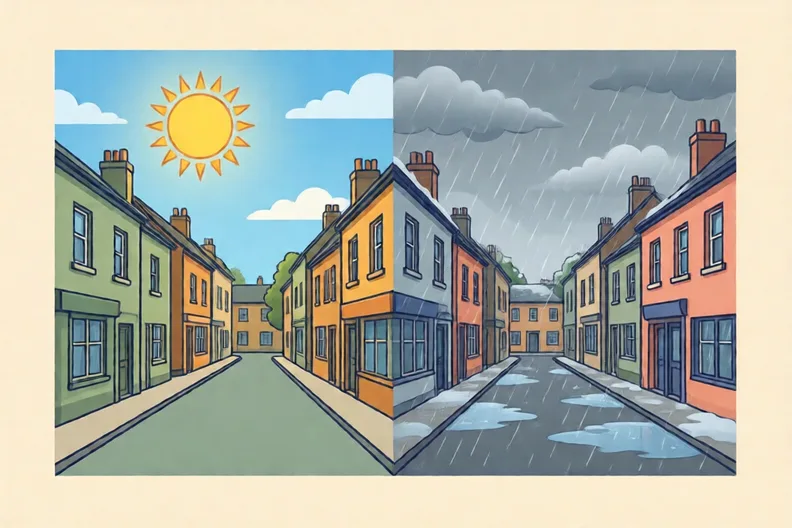
The same town shown twice, sunny on a summer day and grey and wet in winter, no people
  1. 1.

    It is sunny in our town today. Weather or climate?

    weatherclimate
  2. 2.

    Our town is usually cold and wet in winter, year after year. Weather or climate?

    weatherclimate
  3. 3.

    Number these from hottest (1) to coldest (3) on average.

    Average temperature (made up)051015202530Next to a poleOn the equatorHalfway to a pole
    1. A place right next to the North Pole
    2. A place on the equator
    3. A place halfway between the equator and a pole
  4. 4.

    Join each word to its meaning.

    solar energyequatorpolesclimate
    usual weather over about 30 yearscold places at the top and bottomlight and heat from the sunimaginary line around the middle of Earth

Say it out loud: What is the difference between one unusual day and the usual pattern over many years?

D Spot the mistake3 min

A grey street with puddles after rain, with no people
Ali says: “It rained all day on Monday, so our climate is very wet.”
  1. 1.

    Explain to Ali why he is wrong.

E Think deeper3 min
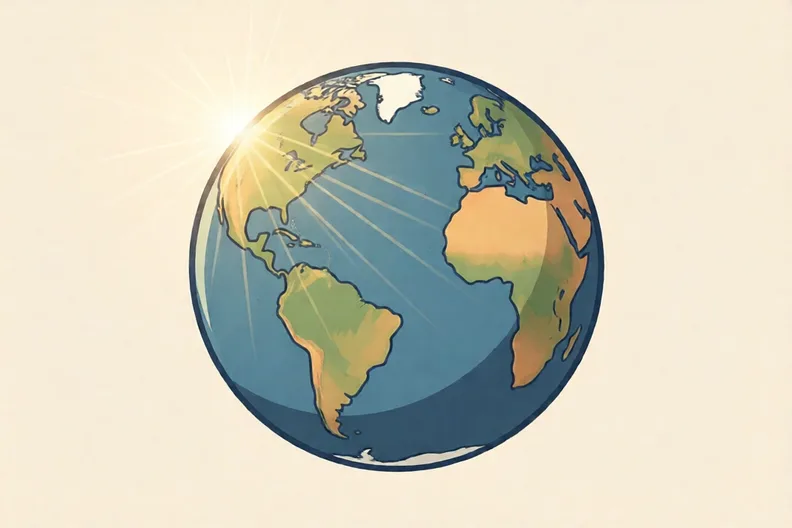
Earth seen from space with sunlight falling on one side
  1. 1.

    Which stays hotter all year: the equator or near the North Pole? Explain how you know.

How did it feel?

I can do it Nearly Not yet
StudyDen · Year 3 · Geography · Climate zones: what are they and why do they matter?Answers are on the grown-up page

For the grown-up

Weather or climate? · 2 minutes to read

Answers, and what a wrong one tells you

A

1. South If your child says East, they have mixed up the points. Find north, then look straight across the middle to the opposite side.

2. D1 If your child writes the number first, remind them to go along the bottom to the letter, then up the side to the number.

3. 5 If your child writes 9, they have added 7 and 2. Ask: is the question asking how many more, so should we take away?

B

1. 10 If your child writes 20, they have added 15 and 5. Ask: which bar is bigger, and how far apart are the two bars?

C

1. weather If your child says climate, ask: does this happen today only, or every year for a long time?

2. climate If your child says weather, ask: is this one day, or the pattern we expect every winter?

3. 1 A place on the equator · 2 A place halfway between the equator and a pole · 3 A place right next to the North Pole If your child puts the pole place first, they think it is hottest. Ask: which place gets the most direct sunlight?

4. solar energy → light and heat from the sun; equator → imaginary line around the middle of Earth; poles → cold places at the top and bottom; climate → usual weather over about 30 years If your child joins climate to the weather of one day, remind them that climate looks back over many years.

D

1. Look for: One wet day is weather; climate is the usual pattern of weather over many years, about 30. If your child agrees that one wet day shows the climate, ask how many years climate looks at. Then ask whether one day is enough.

E

1. Look for: The equator, because the sun's rays are concentrated there, while near the poles they spread over a larger area.

Words to use

Say“Is this one day, or what usually happens over many years?”
Instead of“Tell them weather and climate are the same thing.”

After the sheet

For a week, check the weather from the window each morning and write it down. Then talk about why one week cannot show our climate.

Tick what your child got right in StudyDen. Anything missed comes back in a later Look back box, so there's no need to redo the sheet.

The rest of this unit

5 more sheets come with a StudyDen plan, in teaching order:

  1. Finding climate zones on the map(with a plan)
  2. Reading climate graphs(with a plan)
  3. Zones and biomes(with a plan)
  4. Plant and animal survival(with a plan)
  5. Climate change and us(with a plan)

Every Year 3 geography worksheet

The worksheets plan opens a printable sheet for every lesson in Years 1 to 6, each with its answers on a separate page for you. It costs £6.99 a month or £59 a year for the whole family, with no free trial.

The full StudyDen plan adds the lessons themselves, marked as your child works, with the worksheets included. It is 7 days free, then £29.99 a month.

Both start with a free account; you choose the plan when you sign up.