← Year 3 geography worksheets

Year 3 Rivers: what's special about them? worksheet

“Where rivers begin” is free to print, with no account. It is the first sheet in the Year 3 geography unit “Rivers: what's special about them?”, for children aged 7 to 8, and takes about 22 minutes.

Print it on A4. The child's pages come first; the answers, and what each wrong answer tells you, are on the grown-up page that follows. Weeks 11 to 18 of the year, 8 sheets in the unit.

Free sample · answers on the last page

Where rivers begin

Name: ____________ · Date: ____________
Year 3 · Geography · about 22 minutes
Answers are on the grown-up page

Today I can say where a river starts and ends, and which way it flows.

A Look back3 min

  1. 1.

    The compass shows north at the top. Which direction is opposite to north?

    NNEESESWWNW
    EastSouthWestNorth
  2. 2.

    What is in square B2?

    ABCD1234~N
    TreeHousePondChurch
  3. 3.

    What is in square D1?

    ABCD1234~SN
    ShopParkPondFarm

B Watch me, then you4 min

Ola watches rain run off a hill. Follow the water from the hill all the way to the sea.

Watch me
HillsStreamSea

Water starts high up in the hills.

It flows downhill into a stream.

The stream reaches the sea at the mouth of the river.

Now you
  1. 1.

    Rain runs into a stream, then a river, then a lake. Where did the rain fall first? Tick the answer.

    StreamRiverLake
    Hills or mountainsThe seaThe mouth
  2. 2.

    Which place is the last box, where the river ends?

    HillsStreamRiver
    The sourceThe sea or a lakeA tributary

C Your turn8 min

Work through each row. Notice how the question changes a little each time.
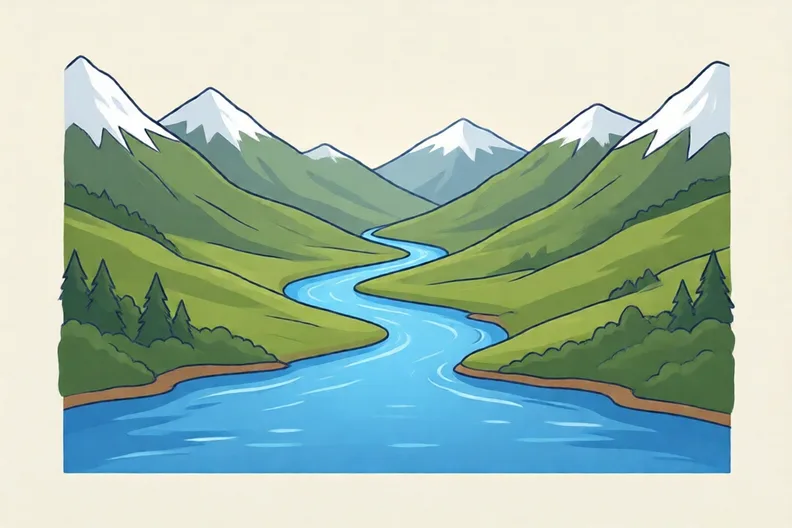
A green valley with a stream running down a slope into a wide river
  1. 1.

    Draw a line to join each word to its meaning.

    SourceMouthTributaryDrainage basin
    A small river that joins a bigger riverAll the land that drains into one river systemWhere a river begins in high landWhere a river enters the sea or a lake
  2. 2.

    Which feature is where a river flows into the sea or a lake?

    HillsStreamRiverLake
    SourceMouthTributaryConfluence
  3. 3.

    Put these steps in order for a raindrop. Write 1 to 4 in the boxes.

    1. The river reaches the sea
    2. Rain lands high in the hills
    3. The stream joins a bigger river
    4. Water trickles into a stream
  4. 4.

    Rain falls on a hill and the water runs to a river. Does it flow uphill or downhill?

    UphillDownhill

Say it out loud: What stayed the same in each question, and what changed? Which word told you where to look?

D Spot the mistake3 min
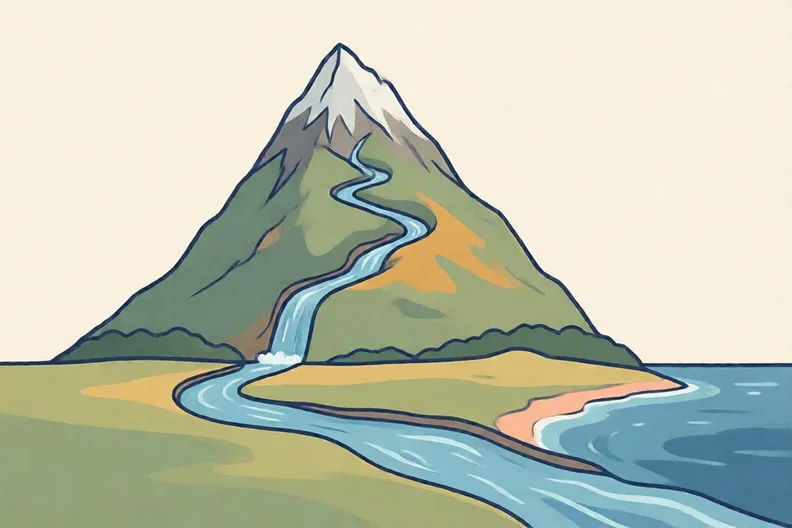
A river beginning on a mountain and flowing down to the sea
Kit says: “Rivers start at the sea and flow up into the hills.”
  1. 1.

    Write one sentence to explain what Kit has wrong.

E Think deeper4 min
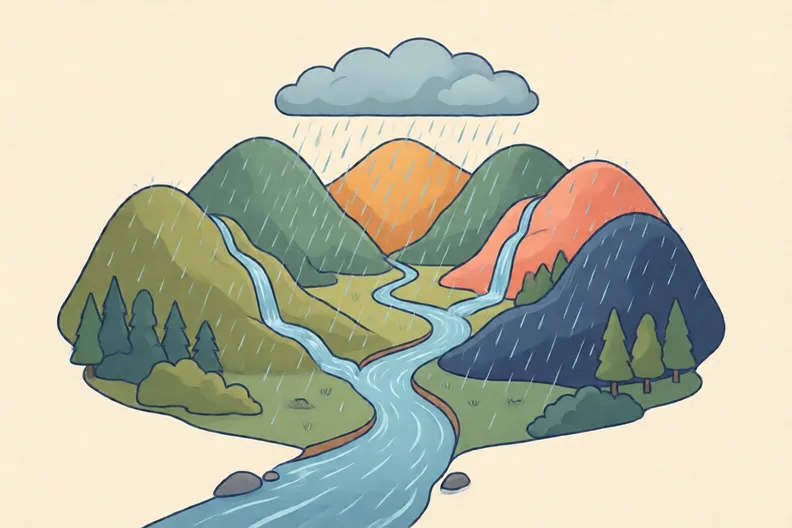
A ring of hills around one valley, with streams from different hills joining one river
  1. 1.

    Two raindrops fall on different hills in this picture. Explain why both could end up in the same river. Use the words drainage basin.

How did it feel?

I can do it Nearly Not yet
StudyDen · Year 3 · Geography · Rivers: what's special about them?Answers are on the grown-up page

For the grown-up

Where rivers begin · 2 minutes to read

Answers, and what a wrong one tells you

A

1. South If your child picks East or West, ask them to point north, then point the opposite way. Opposite north is always south.

2. House If your child picks the symbol in the wrong square, ask them to go along the bottom letter first, then up the side number.

3. Pond If your child reads the wrong row, ask them to find the letter D first, then move to the bottom row for the number 1.

B

1. Hills or mountains If your child picks the sea, ask which end of the river is higher up. Rivers start high and end low.

2. The sea or a lake

C

1. Source → Where a river begins in high land; Mouth → Where a river enters the sea or a lake; Tributary → A small river that joins a bigger river; Drainage basin → All the land that drains into one river system

2. Mouth If your child picks source, ask where the water starts. The source is at the top, so the end of the river is the mouth.

3. 1 Rain lands high in the hills · 2 Water trickles into a stream · 3 The stream joins a bigger river · 4 The river reaches the sea

4. Downhill

D

1. Look for: Says that rivers start high in hills or mountains and flow downhill to the sea or a lake. If your child only writes that Kit is wrong, ask them where the river starts and which way it flows. Then ask them to put that into one sentence.

E

1. Look for: Says both hills are in one drainage basin, so water from each runs downhill into the same river.

Words to use

Say“Where does the water start? Which way does it flow, and where does it end?”
Instead of“Just tell them the answer, or say rivers start at the sea.”

After the sheet

Prop a tray on a book so one end is higher. Pour a cup of water at the top and watch which way it runs. Ask your child where it started and where it ended.

Tick what your child got right in StudyDen. Anything missed comes back in a later Look back box, so there's no need to redo the sheet.

The rest of this unit

7 more sheets come with a StudyDen plan, in teaching order:

  1. How rivers shape the land(with a plan)
  2. Source to mouth(with a plan)
  3. Why rivers overflow(with a plan)
  4. Flood harm and help(with a plan)
  5. Rivers in the UK(with a plan)
  6. Rivers across Europe(with a plan)
  7. Mighty Rivers of the World(with a plan)

Every Year 3 geography worksheet

The worksheets plan opens a printable sheet for every lesson in Years 1 to 6, each with its answers on a separate page for you. It costs £6.99 a month or £59 a year for the whole family, with no free trial.

The full StudyDen plan adds the lessons themselves, marked as your child works, with the worksheets included. It is 7 days free, then £29.99 a month.

Both start with a free account; you choose the plan when you sign up.