← Year 3 geography worksheets

Year 3 The water cycle: why is it important? worksheet

“The water cycle goes round” is free to print, with no account. It is the first sheet in the Year 3 geography unit “The water cycle: why is it important?”, for children aged 7 to 8, and takes about 20 minutes.

Print it on A4. The child's pages come first; the answers, and what each wrong answer tells you, are on the grown-up page that follows. Weeks 5 to 10 of the year, 6 sheets in the unit.

Free sample · answers on the last page

The water cycle goes round

Name: ____________ · Date: ____________
Year 3 · Geography · about 20 minutes
Answers are on the grown-up page

Today I can put the four stages of the water cycle in order and explain why no new water is made.

A Look back3 min

  1. 1.

    The compass shows a letter missing. Circle the direction that is opposite to east.

    NNEESESSWNW
    NorthWestSouth
  2. 2.

    Circle the features on this map that people made.

    ABC123~N
    hillpondhouseshop
  3. 3.

    Circle the direction that is usually at the top of a map.

    NEESESSWWNW
    NorthSouthEastWest

B Watch me, then you4 min

Sam fills a cup with water and leaves it in the sun. Follow the water round the cycle.

Watch me
EvaporationCondensationPrecipitationCollection

The sun warms the water, so it turns into vapour: evaporation.

High up, the vapour cools into droplets: condensation.

The droplets gather and fall as rain: precipitation.

Now you
  1. 1.

    Rain falls from a cloud onto the hills. Circle the stage that is missing from the chain.

    EvaporationCondensationCollection
    EvaporationPrecipitationCondensationCollection

C Your turn6 min

Look at the chain. One stage is hidden. Circle the stage that goes in the gap.

  1. 1.

    The sun warms a lake and water rises into the air. Circle the missing stage.

    CondensationPrecipitationCollection
    EvaporationCondensationPrecipitationCollection
  2. 2.

    Water vapour cools high up and becomes tiny droplets. Circle the missing stage.

    EvaporationPrecipitationCollection
    EvaporationCondensationPrecipitationCollection
  3. 3.

    Water runs into a river and is stored in the sea. Circle the missing stage.

    EvaporationCondensationPrecipitation
    EvaporationCondensationPrecipitationCollection
  4. 4.

    Number these steps from 1 to 4, starting when the sun warms the water.

    1. Water is stored in a lake or sea
    2. Sun warms the water into vapour
    3. Droplets fall as rain
    4. Vapour cools into tiny droplets

Say it out loud: Which stage comes straight after the one you just filled in? What changes between one stage and the next?

D Spot the mistake3 min

Lou says: “The water cycle makes new water every time it rains, so the sea gets a little bigger.”
EvaporationCondensationPrecipitationCollection
  1. 1.

    Write what is wrong with Lou's idea.

E Think deeper3 min
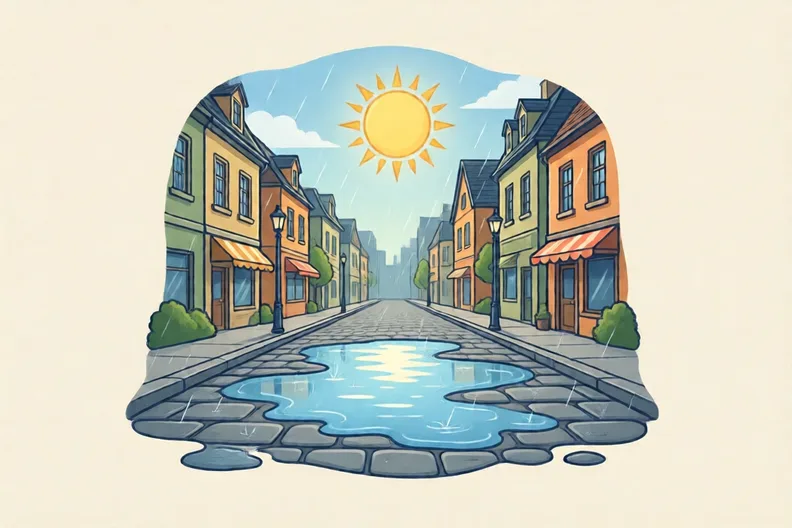
A puddle drying on a paving slab in sunshine
  1. 1.

    The puddle is gone by the afternoon. Where did the water go? Name the stage and say what happens to the water next.

How did it feel?

I can do it Nearly Not yet
StudyDen · Year 3 · Geography · The water cycle: why is it important?Answers are on the grown-up page

For the grown-up

The water cycle goes round · 2 minutes to read

Answers, and what a wrong one tells you

A

1. West If they circle North or South, ask them to stand facing east. Which way is directly behind them?

2. house, shop If they circle the hill or the pond, these are natural features. Ask who built the thing, and whether it was there before people came.

3. North If they circle another direction, ask them to find the compass arrow and check where the top of the page would point.

B

1. Precipitation If they circle Condensation, ask what the droplets are doing. Are they still in the cloud, or have they started to fall as rain?

C

1. Evaporation If they circle Condensation, ask what the sun is doing to the lake. Warming the water is the first step.

2. Condensation If they circle Precipitation, ask whether the droplets have fallen yet. Falling is the stage after this one.

3. Collection If they circle Precipitation, ask where the water goes after it has fallen. Is it still in the air, or has it been stored?

4. 1 Sun warms the water into vapour · 2 Vapour cools into tiny droplets · 3 Droplets fall as rain · 4 Water is stored in a lake or sea If the numbers are in the wrong order, ask them to say the first step out loud, then the next. Each stage makes the next one happen.

D

1. Look for: Says the water cycle does not make new water and that the same water keeps moving round, so the total stays about the same. Lou thinks rain adds water. Pour water from one cup into another, and ask where the water in the second cup came from. It was already there.

E

1. Look for: Names evaporation, with the sun warming the water into vapour in the air, and may name condensation as the vapour cooling into droplets.

Words to use

Say“Which stage comes next? What is the sun doing to the water at this point?”
Instead of“Tell them the four stage names and ask them to copy them out in order.”

After the sheet

Pour a little water into a dish, mark the level with a pen, and leave it in a sunny window. Check it the next day and talk about where the water went.

Tick what your child got right in StudyDen. Anything missed comes back in a later Look back box, so there's no need to redo the sheet.

The rest of this unit

5 more sheets come with a StudyDen plan, in teaching order:

  1. Water Around Our Homes(with a plan)
  2. Who Can Reach Water?(with a plan)
  3. Where Our Water Comes From(with a plan)
  4. Why Tap Water Costs Money(with a plan)
  5. Water is not equal(with a plan)

Every Year 3 geography worksheet

The worksheets plan opens a printable sheet for every lesson in Years 1 to 6, each with its answers on a separate page for you. It costs £6.99 a month or £59 a year for the whole family, with no free trial.

The full StudyDen plan adds the lessons themselves, marked as your child works, with the worksheets included. It is 7 days free, then £29.99 a month.

Both start with a free account; you choose the plan when you sign up.