← Year 4 science worksheets

Year 4 More about food chains worksheet

“Reading food chain arrows” is free to print, with no account. It is the first sheet in the Year 4 science unit “More about food chains”, for children aged 8 to 9, and takes about 24 minutes.

Print it on A4. The child's pages come first; the answers, and what each wrong answer tells you, are on the grown-up page that follows. Weeks 32 to 36 of the year, 10 sheets in the unit.

Free sample · answers on the last page

Reading food chain arrows

Name: ____________ · Date: ____________
Year 4 · Science · about 24 minutes
Answers are on the grown-up page

Today I can read a food chain and say which way its arrows point.

A Look back3 min

  1. 1.

    Water freezes at 0 °C. On this thermometer, is 0 °C below or above 10 °C? Circle one.

    -10°C0°C10°C20°C30°C40°C50°C60°C70°C80°C90°C100°C110°C
    abovebelow
  2. 2.

    This is the life cycle of a flowering plant. Which stage is missing? Circle it.

    seedyoung plantflower
    adult plantseedflower
  3. 3.

    Plants make their own food using sunlight. Which living thing in this chain is a plant? Write it.

    grassrabbitfox

B Watch me, then you4 min

A garden has a leaf, a snail and a thrush. The snail eats the leaf. The thrush eats the snail. Draw the food chain.
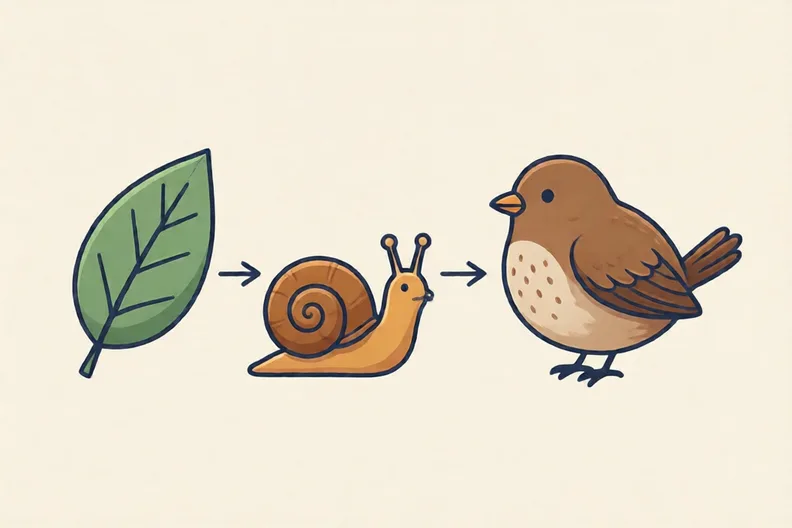
A green leaf, a snail and a brown thrush, with arrows showing the food chain.
Watch me
leafsnailthrush

Write the leaf first, because it is food for the snail.

Each arrow points to the living thing that eats.

leaf → snail → thrush: the leaf is food for the snail, and the snail is food for the thrush.

Now you
  1. 1.

    In this chain, the mouse is food for the ___. Circle the answer.

    seedmouse
    owlseed

C Your turn8 min

Number the living things so the first one is food for the next. Then answer the rest.
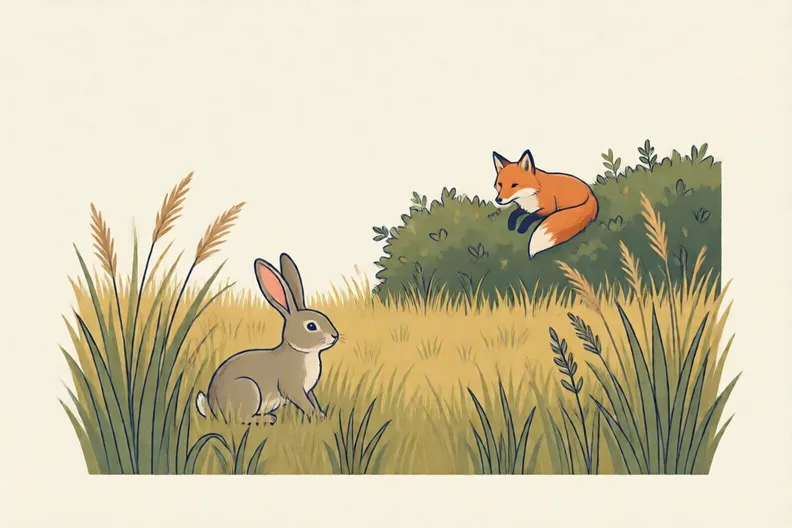
A meadow with grass, a rabbit and a fox at the edge of a hedge
  1. 1.

    Number these 1, 2 and 3. The first is food for the second, and the second is food for the third.

    1. fox
    2. grass
    3. rabbit
  2. 2.

    Now there are four. Number them 1 to 4 from the start of the chain.

    1. thrush
    2. leaf
    3. fox
    4. snail
  3. 3.

    The rabbit eats the grass. Which arrow shows this?

    grass → rabbitrabbit → grass
  4. 4.

    Join each animal to the food it eats.

    cowlionhedgehog
    beetles and fruitother animalsgrass and hay

Say it out loud: What changed from one row to the next? Which way did the arrows point each time?

D Spot the mistake3 min

Ali says: “In grass → rabbit, the arrow means eats, so the grass eats the rabbit.”
grassrabbitfox
  1. 1.

    Which living thing really eats the other? Circle it.

    grassrabbit

E Think deeper4 min

  1. 1.

    In a pond, algae are food for snails, and snails are food for ducks. Explain what happens to the ducks if all the algae disappear. Write 2 sentences.

    algaesnailduck

How did it feel?

I can do it Nearly Not yet
StudyDen · Year 4 · Science · More about food chainsAnswers are on the grown-up page

For the grown-up

Reading food chain arrows · 2 minutes to read

Answers, and what a wrong one tells you

A

1. below Higher numbers sit higher up the scale. Ask your child to point to 0 and then to 10 with a finger, and say which is higher.

2. adult plant The young plant grows into the adult plant, then makes flowers. Ask your child to trace the arrows round the circle in order.

3. Look for: Names the grass. If your child writes rabbit, ask whether a rabbit can make food from sunlight. The grass is the plant.

B

1. owl If your child circles seed, the arrow is the wrong way round. Ask which living thing eats the mouse.

C

1. 1 grass · 2 rabbit · 3 fox If your child puts the fox first, ask: what does the fox eat? Start from the thing that is eaten.

2. 1 leaf · 2 snail · 3 thrush · 4 fox

3. grass → rabbit

4. cow → grass and hay; lion → other animals; hedgehog → beetles and fruit

D

1. rabbit Ali read the arrow as 'eats'. Ask your child to read it as 'is food for': the grass is food for the rabbit.

E

1. Look for: Says the snails lose their food, so there are fewer snails, so the ducks have less food.

Words to use

Say“Read each arrow out loud as 'is food for'. Which living thing is at the start of the chain?”
Instead of“Tell them arrows mean 'eats' and move on before they have read the chain.”

After the sheet

Pick three things you can see from a window, such as a tree, a bird and a worm. Write them as a chain with arrows that mean 'is food for'.

Tick what your child got right in StudyDen. Anything missed comes back in a later Look back box, so there's no need to redo the sheet.

The rest of this unit

9 more sheets come with a StudyDen plan, in teaching order:

  1. Plants Start the Chain(with a plan)
  2. Every link matters(with a plan)
  3. Predators and prey(with a plan)
  4. Building food chains(with a plan)
  5. Comparing food chains(with a plan)
  6. Presenting food chains(with a plan)
  7. Changes in food chains(with a plan)
  8. Dangers to food chains(with a plan)
  9. Protecting food chains(with a plan)

Every Year 4 science worksheet

The worksheets plan opens a printable sheet for every lesson in Years 1 to 6, each with its answers on a separate page for you. It costs £6.99 a month or £59 a year for the whole family, with no free trial.

The full StudyDen plan adds the lessons themselves, marked as your child works, with the worksheets included. It is 7 days free, then £29.99 a month.

Both start with a free account; you choose the plan when you sign up.