← Year 5 science worksheets

Year 5 Human development worksheet

“Life before and after birth” is free to print, with no account. It is the first sheet in the Year 5 science unit “Human development”, for children aged 9 to 10, and takes about 20 minutes.

Print it on A4. The child's pages come first; the answers, and what each wrong answer tells you, are on the grown-up page that follows. Weeks 31 to 36 of the year, 11 sheets in the unit.

Free sample · answers on the last page

Life before and after birth

Name: ____________ · Date: ____________
Year 5 · Science · about 20 minutes
Answers are on the grown-up page

Today I can describe how a baby grows in the womb and changes in its first year.

A Look back3 min

  1. 1.

    In a frog’s life cycle, what comes between the egg and the young frog? Circle one.

    frog eggyoung frogadult frog
    tadpolechickkittenseed
  2. 2.

    In a food chain, the arrows point to the ___. Circle one.

    grassrabbitfox
    eaterplantsunsoil
  3. 3.

    Circle the mammal. The cycle shows how a mammal starts life.

    Born aliveDrinksmother's milkGrows intoadultHas young
    HenCowFrog

B Watch me, then you4 min

A human starts as one tiny cell. It grows and develops inside its mother’s womb. Watch how the chain shows this.

Watch me
One cellGrows in the wombBorn

A human starts as one tiny cell.

It grows and develops in the womb for about nine months.

Then the baby is born and needs care from adults.

Now you
  1. 1.

    Where does a baby grow before it is born? Circle the word that fills the gap in the chain.

    One cellBorn
    stomachwomblungsheart
  2. 2.

    Write each card under the right heading.

    Organs begin to formGrows in the wombFeeds on milkLearns to sit up
    Before birthAfter birth

C Your turn7 min

Most babies push up on their tummy at about 4 months and sit up at about 6 months. They stand holding furniture at about 9 months and take first steps alone at about 12 months. Each chain has one gap. Read the milestone, then circle the age that fits the gap.

  1. 1.

    Most babies sit up on their own around which age? Circle one.

    NewbornMonth 4Month 9Month 12
    five monthssix monthsseven monthseight months
  2. 2.

    Most babies stand up, holding furniture, around which age? Circle one.

    NewbornMonth 4Month 6Month 12
    seven monthseight monthsnine monthsten months
  3. 3.

    Which age is it when a baby starts pushing its chest up and can often turn over? Circle one.

    NewbornMonth 6Month 9Month 12
    two monthsthree monthsfour monthsfive months
  4. 4.

    Put these milestones in order from youngest baby to oldest. Write 1 to 4 in the boxes.

    NewbornMonth 4Month 6Month 9Month 12
    1. Take first steps alone
    2. Stand holding furniture
    3. Sit up on their own
    4. Push up on tummy

Say it out loud: What changed from one row to the next? Did the milestone change, the gap move, or both?

D Spot the mistake3 min

Kit says: “A baby grows in its mother’s stomach until it is ready to be born.”
FoodStomachFood broken down
  1. 1.

    Where does a baby really grow? Write one sentence to tell Kit.

E Think deeper4 min

A newborn foal can stand and walk within hours. A newborn human baby cannot.
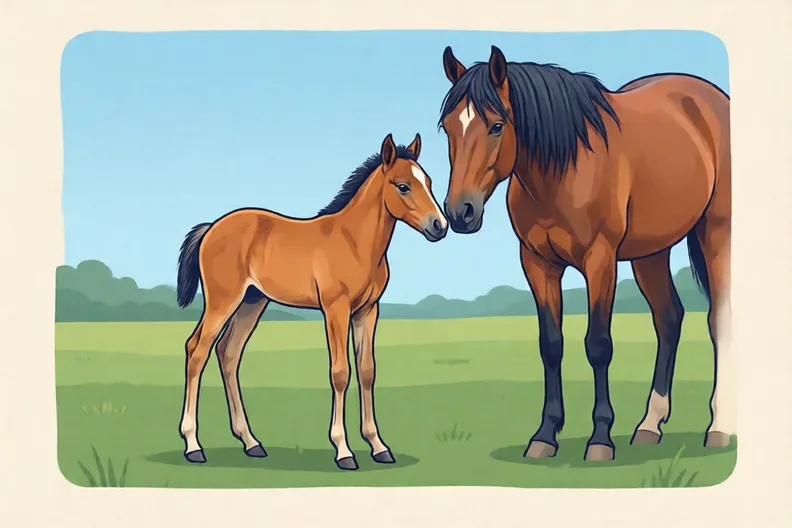
A newborn foal standing on long legs in a green field
  1. 1.

    Explain why a human baby needs years of care, but a foal does not. Use one idea from this lesson.

How did it feel?

I can do it Nearly Not yet
StudyDen · Year 5 · Science · Human developmentAnswers are on the grown-up page

For the grown-up

Life before and after birth · 2 minutes to read

Answers, and what a wrong one tells you

A

1. tadpole If they pick chick, remind them a frog hatches from an egg in water. Ask what it looks like before it has legs.

2. eater If they pick plant, ask which animal eats the grass. The arrow goes from the grass to the rabbit, the one that eats it.

3. Cow If they circle hen or frog, ask what mammals have on their bodies. A mammal has hair or fur and feeds its young with milk.

B

1. womb If they circle stomach, ask what the stomach does. It breaks down food. A baby grows in the womb.

2. After birth: Feeds on milk, Learns to sit up · Before birth: Organs begin to form, Grows in the womb If a card is in the wrong column, ask whether the baby is still inside the mother or already born.

C

1. six months If they choose another age, read the box at the top together. Most babies sit up at about six months, after pushing up at four months.

2. nine months If they choose another age, read the box at the top together. Most babies stand holding furniture at about nine months, before they walk at twelve.

3. four months If they choose another age, read the box at the top together. Pushing up comes at about four months, before sitting up at six.

4. 1 Push up on tummy · 2 Sit up on their own · 3 Stand holding furniture · 4 Take first steps alone If walking comes first, remind them that babies learn to push up and sit before they can stand and walk.

D

1. Look for: Says Kit is wrong and names the womb as the place a baby grows, not the stomach. If they say the stomach is right, look at the chain together. The stomach breaks down food. A baby grows in the womb, which is a different organ.

E

1. Look for: Says a human baby is helpless at birth and takes months to learn to sit, stand and walk, so it needs adults to care for it.

Words to use

Say“Which stage comes first, and how do you know? Show me on the chain.”
Instead of“Just tell them the answer, or say the stomach is where babies grow.”

After the sheet

Write Newborn, 4, 6, 9 and 12 months on five scraps of paper in a line. Put a coin on each one as you say what a baby can do at that age. Then take the coins away and say the stages back.

Tick what your child got right in StudyDen. Anything missed comes back in a later Look back box, so there's no need to redo the sheet.

The rest of this unit

10 more sheets come with a StudyDen plan, in teaching order:

  1. Changes in childhood(with a plan)
  2. Puberty and Adolescence(with a plan)
  3. Changes in adulthood(with a plan)
  4. Changes as people get older(with a plan)
  5. Planning Our Human Survey(with a plan)
  6. Measuring height fairly(with a plan)
  7. Growth and averages(with a plan)
  8. Reading growth bar charts(with a plan)
  9. How long do people live?(with a plan)
  10. What makes population grow?(with a plan)

Every Year 5 science worksheet

The worksheets plan opens a printable sheet for every lesson in Years 1 to 6, each with its answers on a separate page for you. It costs £6.99 a month or £59 a year for the whole family, with no free trial.

The full StudyDen plan adds the lessons themselves, marked as your child works, with the worksheets included. It is 7 days free, then £29.99 a month.

Both start with a free account; you choose the plan when you sign up.