← Year 6 art worksheets

Year 6 Urban Life: Drawing and design worksheet

“Seeing the City Plan” is free to print, with no account. It is the first sheet in the Year 6 art unit “Urban Life: Drawing and design”, for children aged 10 to 11, and takes about 20 minutes.

Print it on A4. The child's pages come first; the answers, and what each wrong answer tells you, are on the grown-up page that follows. Weeks 4 to 8 of the year, 6 sheets in the unit.

Free sample · answers on the last page

Seeing the City Plan

Name: ____________ · Date: ____________
Year 6 · Art & design · about 20 minutes
Answers are on the grown-up page

Today I can explain that urban design includes public spaces, and spot perspective and symmetry in a street.

A Look back3 min

  1. 1.

    Circle the name of this shape.

    trianglesquarepentagoncircle
  2. 2.

    Circle the name of this 3D shape.

    cubecuboidconesphere
  3. 3.

    Circle the primary colours.

    redgreenblueorange
    redgreenblueorange

B Watch me, then you4 min

Ola is making a plan of a small town. Which symbol shows a space that anyone can walk into and use?
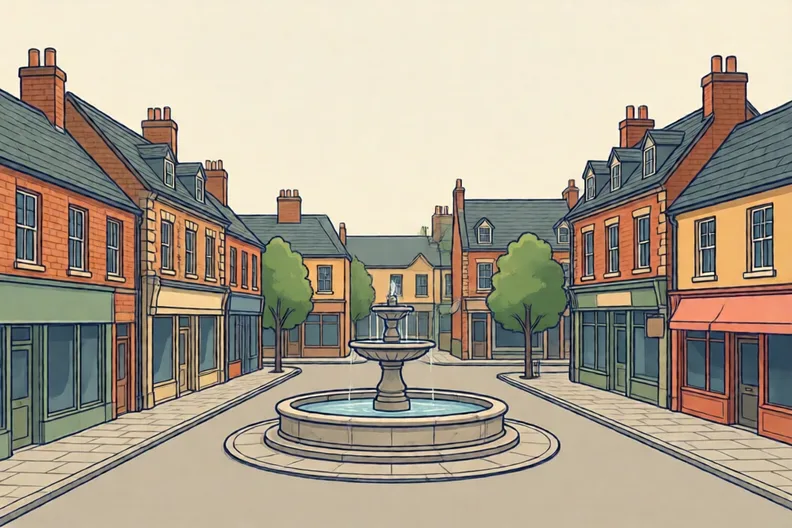
A small town square with a fountain, shop fronts and tall brick buildings, with no people
Watch me
ABC123SN

A house is someone's private home, so it is not public.

A park is open for anyone to walk into and use.

So the park is a public space on Ola's plan.

Now you
  1. 1.

    Circle the symbol that shows a space anyone can walk into and use.

    ABC123SN
    houseschoolpark

C Your turn8 min

Work through each row. Each one looks at a different part of a drawing or a plan.
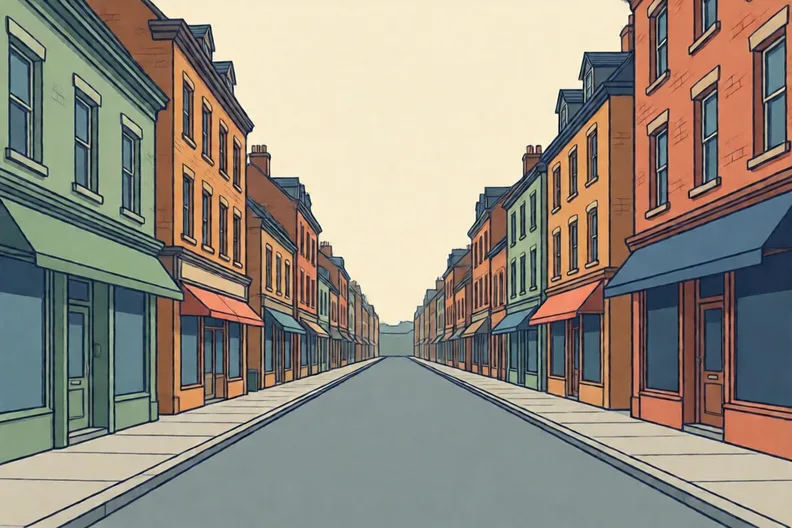
A town street drawn in perspective with no people
  1. 1.

    Join each word to its meaning.

    cityscapevanishing pointsymmetry
    a picture of a citytwo halves that mirror each otherwhere parallel lines seem to meet
  2. 2.

    Which shape has a line of symmetry down its middle: a square, or the parallelogram in the picture? Circle it.

    squareparallelogram
  3. 3.

    Sort these cards into the two columns.

    ABC123SN
    a zebra crossing on a busy roada park bench in a town squarea cycle lane beside the roada wild forest with no paths
    Designed for everyoneNot part of urban design
  4. 4.

    Look at the street picture above. Name one pattern that repeats along it, and say where on the street you see it.

Say it out loud: Which of these ideas do you see in a real street near your home?

D Spot the mistake3 min

Kit says: “Urban design is only about building the houses, so a park is not part of it.”
ABC123N
  1. 1.

    Write what Kit has missed.

E Think deeper4 min

  1. 1.

    Look at this town plan. Which things would a designer think about first? Write your ideas and a reason.

    ABC123SN

How did it feel?

I can do it Nearly Not yet
StudyDen · Year 6 · Art & design · Urban Life: Drawing and designAnswers are on the grown-up page

For the grown-up

Seeing the City Plan · 2 minutes to read

Answers, and what a wrong one tells you

A

1. square

2. cuboid If your child circles cube, ask whether all the edges are the same length. If not, it is a cuboid.

3. red, blue

B

1. park If your child circles school, ask whether anyone can walk in whenever they like. A school is only open to its pupils and staff.

C

1. cityscape → a picture of a city; vanishing point → where parallel lines seem to meet; symmetry → two halves that mirror each other

2. square If your child circles parallelogram, ask them to fold the shape in half. Does one half land exactly on the other? A parallelogram does not fold that way.

3. Designed for everyone: a zebra crossing on a busy road, a park bench in a town square, a cycle lane beside the road · Not part of urban design: a wild forest with no paths

4. Look for: A named repeating feature of a street, such as windows, bricks, lamp posts or railings, with a place where it is seen.

D

1. Look for: Says urban design also covers parks, streets, and public spaces as well as buildings, so a park is part of it. If your child only agrees with Kit, ask who decided where the park goes and how people reach it. That decision is urban design.

E

1. Look for: At least one sensible urban design idea, such as walking routes, places to sit, safe crossings, green space or wildlife, with a reason.

Words to use

Say“Where would people walk, sit or cross here? Why do you think the designer put it there?”
Instead of“Tell them the right name for every building and move on.”

After the sheet

Stand a row of four tins or boxes on the table. Look from one end, then draw what you see with a ruler, letting the far ones get smaller.

Tick what your child got right in StudyDen. Anything missed comes back in a later Look back box, so there's no need to redo the sheet.

The rest of this unit

5 more sheets come with a StudyDen plan, in teaching order:

  1. Looking closely at a city(with a plan)
  2. The five stages of design(with a plan)
  3. Design a play space(with a plan)
  4. Designing for urban wildlife(with a plan)
  5. Designing sustainable transport(with a plan)

Every Year 6 art worksheet

The worksheets plan opens a printable sheet for every lesson in Years 1 to 6, each with its answers on a separate page for you. It costs £6.99 a month or £59 a year for the whole family, with no free trial.

The full StudyDen plan adds the lessons themselves, marked as your child works, with the worksheets included. It is 7 days free, then £29.99 a month.

Both start with a free account; you choose the plan when you sign up.