← Year 6 geography worksheets

Year 6 Earthquakes: how do they change the world? worksheet

“Why the ground shakes” is free to print, with no account. It is the first sheet in the Year 6 geography unit “Earthquakes: how do they change the world?”, for children aged 10 to 11, and takes about 22 minutes.

Print it on A4. The child's pages come first; the answers, and what each wrong answer tells you, are on the grown-up page that follows. Weeks 3 to 6 of the year, 7 sheets in the unit.

Free sample · answers on the last page

Why the ground shakes

Name: ____________ · Date: ____________
Year 6 · Geography · about 22 minutes
Answers are on the grown-up page

Today I can explain why earthquakes happen at plate boundaries and are not random.

A Look back3 min

  1. 1.

    Circle the compass point that is opposite north.

    NNEESESWWNW
    SouthEastWest
  2. 2.

    The school is in which square? Circle it.

    ABCD1234SN
    A1C2B4D3
  3. 3.

    Which month had the most rain? Circle one.

    Rain in a made-up town0102030405060JanFebMarApr
    JanFebMarApr

B Watch me, then you4 min

In a made-up valley, two plates rub together. Follow the cycle to see how the ground shakes.

Watch me
Plates grindtogetherPressurebuilds upPressure isreleasedGround shakes

Two plates grind together at a boundary.

Pressure builds up over a long time.

A sudden release sends shock waves through the rock.

The ground shakes. That is an earthquake.

Now you
  1. 1.

    Circle the missing step in the cycle.

    Platesslide pastPressurebuilds upGround shakes
    Pressure is releasedPlates stop moving for everRain falls on the ground
  2. 2.

    Circle the first step in the cycle.

    Pressurebuilds upPressure isreleasedGround shakes
    Plates push togetherGround shakesPressure is released

C Your turn8 min

Use the bar chart. In this made-up country, Coast A and Coast B lie along a plate boundary. Inland C and Inland D are far from it.

Earthquakes in a made-up year012345678910Coast ACoast BInland CInland D
  1. 1.

    Which place had the most earthquakes? Circle one.

    Coast ACoast BInland CInland D
  2. 2.

    Which place had the fewest earthquakes? Circle one.

    Coast ACoast BInland CInland D
  3. 3.

    Where do most earthquakes happen? Circle one.

    At plate boundariesRandomly all over the worldOnly on flat deserts
  4. 4.

    Join each plate movement to its boundary. Con- means together, as in connect. Draw a line from each card on the left to one card on the right.

    Plates push togetherPlates move apart
    Divergent boundaryConvergent boundary

Say it out loud: Why are the bars for Coast A and Coast B taller than the bars for Inland C and Inland D?

D Spot the mistake3 min
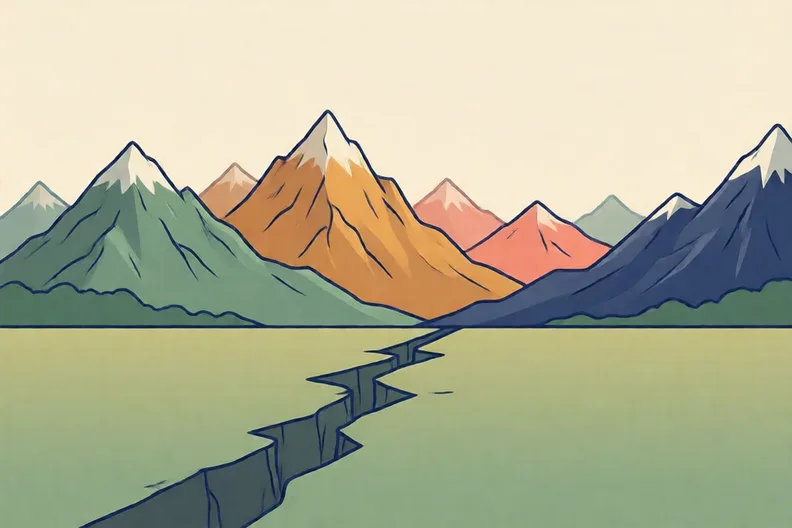
A row of mountains rising along the edge of a broad cracked plain
Lou says: “Earthquakes are random, so they can strike anywhere with an equal chance.”
  1. 1.

    Write one sentence to tell Lou why he is wrong.

E Think deeper4 min

  1. 1.

    In this made-up map, two plates push together under the line of hills. Name one square on that line where shaking is likely, and explain why.

    ABCD1234SN

How did it feel?

I can do it Nearly Not yet
StudyDen · Year 6 · Geography · Earthquakes: how do they change the world?Answers are on the grown-up page

For the grown-up

Why the ground shakes · 2 minutes to read

Answers, and what a wrong one tells you

A

1. South If they circle East or West, ask them to face north, then point to the spot straight behind them.

2. C2 If they circle another square, ask your child to put a finger on the school, then read down to the letter and across to the number.

3. Mar If they circle Feb, they may have picked the second tall bar. Ask them which bar reaches highest.

B

1. Pressure is released If they circle the plates stopping, remind your child that the plates keep moving. The pressure builds until it is released.

2. Plates push together If they circle Ground shakes, ask what must happen before the ground can shake. Pressure has to build first.

C

1. Coast A If they circle Inland D, they may be reading the last bar in the row. Ask them to find the tallest bar first.

2. Inland D If they circle Inland C, they have found a short bar but not the shortest. Ask them to compare the two shortest bars.

3. At plate boundaries If they circle randomly, ask your child what pressure does at the edges of plates. Point them back to the bar chart: the places on the plate boundary have the taller bars.

4. Plates push together → Convergent boundary; Plates move apart → Divergent boundary If they join the two cards the wrong way round, ask your child whether the plates are coming together or moving away from each other. Then ask which word means coming together.

D

1. Look for: earthquakes are not random; most happen at plate boundaries where pressure builds up If they agree with Lou, ask your child what happens at the edges of the plates. Point them to the row of mountains and the crack in the scene, where two plates meet.

E

1. Look for: a square on the line of hills, with a reason about plates pushing together or meeting and pressure building

Words to use

Say“Where do you think the shaking starts, and what makes you think that?”
Instead of“Earthquakes just happen, so there is nothing to work out.”

After the sheet

Slide two biscuits past each other on a table, then press them together. Ask where the pushing and sliding would be strongest.

Tick what your child got right in StudyDen. Anything missed comes back in a later Look back box, so there's no need to redo the sheet.

The rest of this unit

6 more sheets come with a StudyDen plan, in teaching order:

  1. Measuring earthquakes(with a plan)
  2. Where earthquakes happen(with a plan)
  3. Earthquake to tsunami(with a plan)
  4. Getting ready for earthquakes(with a plan)
  5. Turkey 2023: Quakes and Response(with a plan)
  6. Quakes near and far from plate boundaries(with a plan)

Every Year 6 geography worksheet

The worksheets plan opens a printable sheet for every lesson in Years 1 to 6, each with its answers on a separate page for you. It costs £6.99 a month or £59 a year for the whole family, with no free trial.

The full StudyDen plan adds the lessons themselves, marked as your child works, with the worksheets included. It is 7 days free, then £29.99 a month.

Both start with a free account; you choose the plan when you sign up.