← Year 6 geography worksheets

Year 6 Time zones: can we time travel on planet Earth? worksheet

“Why we have day and night” is free to print, with no account. It is the first sheet in the Year 6 geography unit “Time zones: can we time travel on planet Earth?”, for children aged 10 to 11, and takes about 20 minutes.

Print it on A4. The child's pages come first; the answers, and what each wrong answer tells you, are on the grown-up page that follows. Weeks 1 to 3 of the year, 5 sheets in the unit.

Free sample · answers on the last page

Why we have day and night

Name: ____________ · Date: ____________
Year 6 · Geography · about 20 minutes
Answers are on the grown-up page

Today I can explain why we have day and night, and how Earth's spin causes them.

A Look back3 min

  1. 1.

    What is in square B2 on this map? Circle the word.

    ABCD123~SN
    pondschoolchurchtree
  2. 2.

    Which compass point is opposite north? Circle the word.

    NNEESESWWNW
    EastSouthWest
  3. 3.

    Which month had the most rain? Circle the month.

    Rain in a made-up town (mm)010203040506070JanFebMarApr
    JanFebMarApr

B Watch me, then you4 min

Ali watches the sun come up. It rises in the east in the morning. Where does it set in the evening?

Watch me
NNEESESSWWNW

East is one point on the compass.

West is the point opposite east.

So the sun sets in the west.

Now you
  1. 1.

    At midday in the UK, the sun is in the south. Ali faces the sun. Which point is behind Ali? Circle it.

    NEESESSWWNW
    EastWestSouthNorth

C Your turn6 min

A torch lights one side of a globe in a dark room. Each row changes one thing. Read it carefully before you circle.
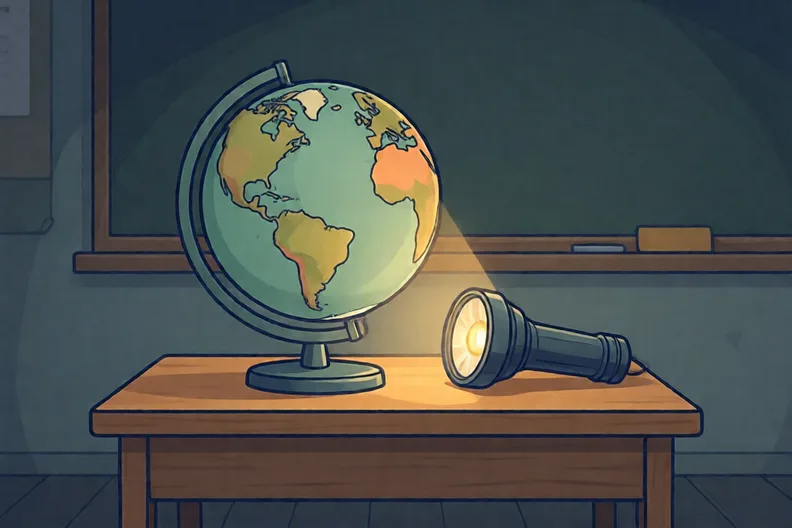
A classroom globe on a desk in a dim room, lit from one side by a torch
  1. 1.

    The torch lights the left side of the globe. Which side is in darkness? Circle it.

    Left sideRight side
  2. 2.

    The torch stays on the left. Ali sticks a star on the lit side, then turns the globe halfway round. Which side is the star on now? Circle it.

    Left sideRight side
  3. 3.

    Ali lives on the half of Earth that faces the sun. Is it day or night for Ali? Circle it.

    DayNight
  4. 4.

    Earth keeps spinning and Ali's half turns away from the sun. Is it day or night for Ali now? Circle it.

    DayNight

Say it out loud: What did you change in this row? What stayed the same?

D Spot the mistake3 min
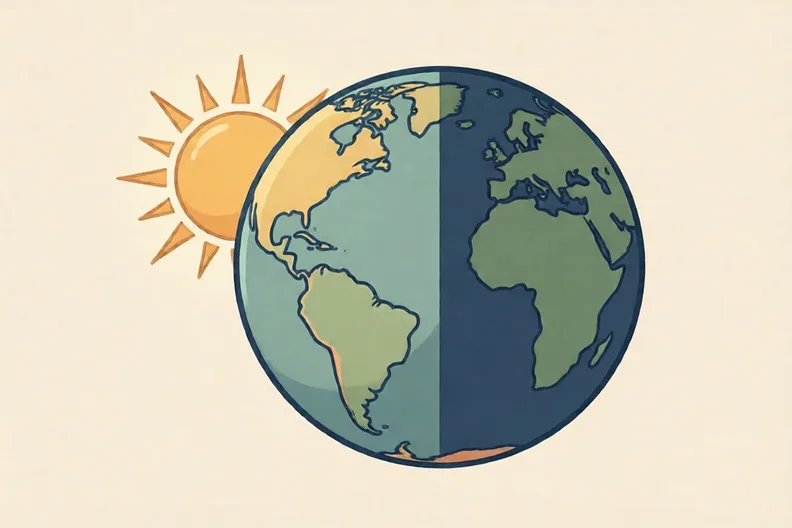
The sun on one side of a globe, with the half of the globe facing it lit
Kit says: “The sun travels round the Earth once a day, so that is why we get night.”
  1. 1.

    Kit's idea is wrong. What really makes day and night? Write two or three sentences.

E Think deeper4 min
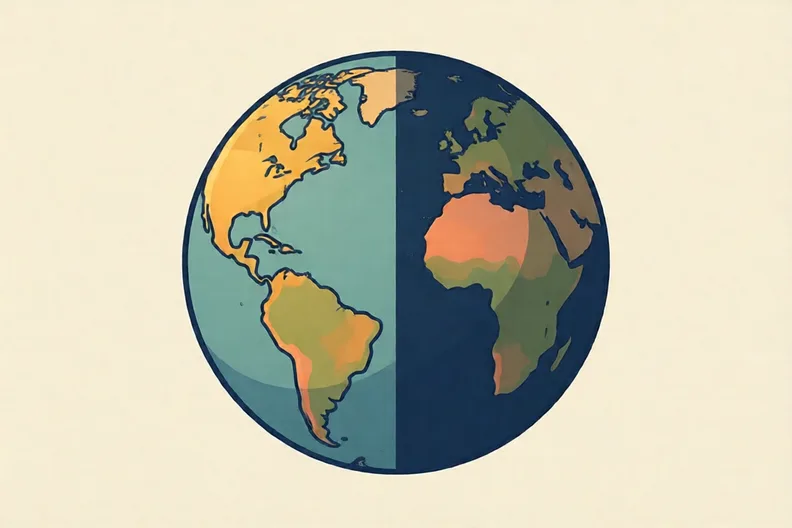
Earth seen from space, half in sunlight and half in darkness
  1. 1.

    Ali says: “When it is night here, it is night everywhere.” Explain why Ali is wrong. Name two places that could be in day at the same time as a place in darkness.

How did it feel?

I can do it Nearly Not yet
StudyDen · Year 6 · Geography · Time zones: can we time travel on planet Earth?Answers are on the grown-up page

For the grown-up

Why we have day and night · 2 minutes to read

Answers, and what a wrong one tells you

A

1. pond If they pick church or tree, they have gone up to row 3. Ask them to go along the bottom to B first, then up to 2.

2. South If they pick East or West, they have chosen a point at the side. Ask them to face north, then turn to face the opposite way.

3. Mar If they pick Jan, they have chosen the first bar. Ask them to find the tallest bar, then read its label.

B

1. North If they pick South, they have chosen the way Ali is facing. Ask them to face the sun, then point behind them.

C

1. Right side If they pick Left side, they have circled the lit side. Ask them to point to the side the torch can reach.

2. Right side If they pick Left side, they have not turned the globe in their head. Ask them to turn a ball halfway and follow the star.

3. Day

4. Night If they say Day, they have not turned Ali's half in their head. Ask them whether Ali's half is facing the sun or turned away.

D

1. Look for: Earth spinning on its axis, so each place turns towards the sun for day and away from it for night, not the sun moving. If they repeat that the sun moves round Earth, ask them to turn slowly on the spot while a lamp stays still. Ask which one moves.

E

1. Look for: Explains that only the half facing the sun has day as Earth spins, and names two places in day while another place has night, such as Australia and New Zealand during UK night.

Words to use

Say“Where is the sun in this room, and which thing is turning, the sun or the ball?”
Instead of“Tell them the sun goes round the Earth every day.”

After the sheet

Shine a torch at a ball or large fruit in a dark room. Turn the ball slowly and watch which side goes dark.

Tick what your child got right in StudyDen. Anything missed comes back in a later Look back box, so there's no need to redo the sheet.

The rest of this unit

4 more sheets come with a StudyDen plan, in teaching order:

  1. Time zones and longitude(with a plan)
  2. Crossing the Date Line(with a plan)
  3. Time zones on the move(with a plan)
  4. Time zones on a digital map(with a plan)

Every Year 6 geography worksheet

The worksheets plan opens a printable sheet for every lesson in Years 1 to 6, each with its answers on a separate page for you. It costs £6.99 a month or £59 a year for the whole family, with no free trial.

The full StudyDen plan adds the lessons themselves, marked as your child works, with the worksheets included. It is 7 days free, then £29.99 a month.

Both start with a free account; you choose the plan when you sign up.