← Year 6 PE worksheets

Year 6 Athletics: athletic challenges refined worksheet

“Sprint for your own best” is free to print, with no account. It is the first sheet in the Year 6 PE unit “Athletics: athletic challenges refined”, for children aged 10 to 11, and takes about 23 minutes.

Print it on A4. The child's pages come first; the answers, and what each wrong answer tells you, are on the grown-up page that follows. Weeks 28 to 30 of the year, 6 sheets in the unit.

Free sample · answers on the last page

Sprint for your own best

Name: ____________ · Date: ____________
Year 6 · PE · about 23 minutes
Answers are on the grown-up page

Today I can keep my head still and swing my arms straight forward and back when sprinting, and measure my own best.

A Look back3 min

Quick memory check from earlier PE. Keep your space clear and a grown-up watching.

  1. 1.

    Number each step from 1 to 3 for a safe race day.

    1. Race your team
    2. Cool down with gentle walking
    3. Warm up with easy jogging
  2. 2.

    Your two sprint times were 12.4 seconds and 12.9 seconds. Which was your faster run, and how do you know?

    12.412.9
  3. 3.

    Where is a safe place to run? Circle one card.

    Clear spaceGrown-up watchingSafe to run
    The open park, away from the roadNext to the roadClose to the window

B Watch me, then you4 min

Ola runs three 100 metre sprints on a clear school field, with a grown-up watching. Her sprint times are shown in seconds. The fastest time is the smallest number.

Watch me
Ola's sprint times (seconds)01234567891011121314151617181920Try 1Try 2Try 3

The smallest time is the fastest try.

Try 3 at 14 seconds is Ola's best so far.

Ola has beaten her own best, which is the goal.

Now you
  1. 1.

    Priya's sprint times were 17, 16 and 18 seconds. Which try was her best? Circle one card.

    Priya's sprint times (seconds)01234567891011121314151617181920Try 1Try 2Try 3
    Try 1Try 2Try 3

C Your turn8 min

Four quick jobs on a clear grass track or garden path. Stop if anything feels unsafe.
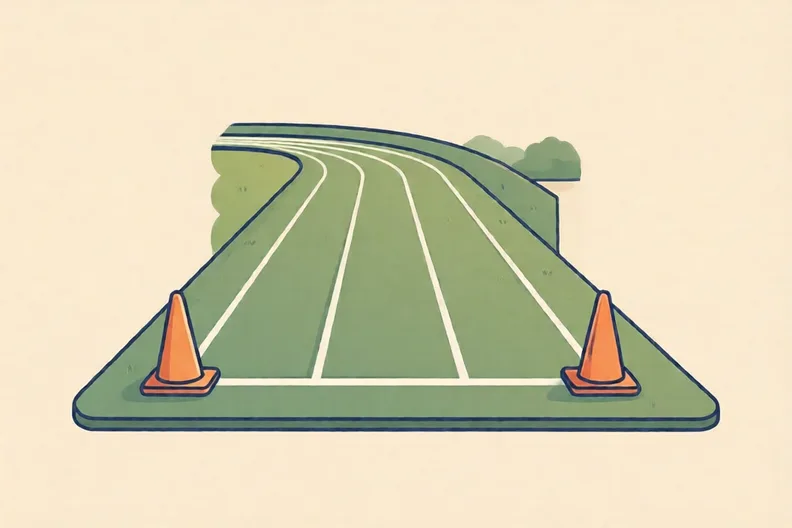
A grass running track with white lane lines and two orange cones, no people
  1. 1.

    Number these steps for the start of a sprint, 1 to 4.

    1. Drive your arms in a straight line
    2. Stand ready behind the start line
    3. Push hard off the ground
    4. Lean slightly forward from the hips
  2. 2.

    Match each card on the left to the tip on the right. Draw a line to join each pair.

    HeadArmsKneesReceiver
    Lift them high to push speedStart moving before the baton arrivesKeep still and face forwardBend to about 90 degrees and swing straight
  3. 3.

    Ali's arms cross over his chest when he runs. Which tip helps him most? Circle one card.

    Swing your arms straight forward and backSwing your arms across your bodyHold your arms still at your sides
  4. 4.

    Run 10 metres three times. Write each time in seconds in the bars. Try 1 Try 2 Try 3

    My three sprints (seconds)012345678910Try 1Try 2Try 3

Say it out loud: Which one tip made the biggest difference to how you ran? Tell your grown-up why.

D Spot the mistake3 min
A sunny school field with a white finish line painted across the grass, no people
Ali says: “Watching my feet keeps me straight, so I run faster.”
  1. 1.

    What is wrong with Ali's idea? Write two lines.

E Think deeper3 min

  1. 1.

    Your three sprint times were 15, 14 and 13 seconds, but you came last in each race. Write two sentences: why were these still good runs?

    My sprint times (seconds)01234567891011121314151617181920Try 1Try 2Try 3

How did it feel?2 min

Tell your grown-up one thing you did with your head or arms that felt better. Then say how it felt to race against your own best.

I can do it Nearly Not yet
StudyDen · Year 6 · PE · Athletics: athletic challenges refinedAnswers are on the grown-up page

For the grown-up

Sprint for your own best · 2 minutes to read

Answers, and what a wrong one tells you

A

1. 1 Warm up with easy jogging · 2 Race your team · 3 Cool down with gentle walking If your child puts the race first, remind them that muscles need warming up before fast running.

2. Look for: Names 12.4 seconds as faster, because a smaller time means a quicker run.

3. The open park, away from the road

B

1. Try 2 If your child circles Try 3, that is the tallest bar and the slowest time. Remind them that for sprints, the smallest number is the fastest.

C

1. 1 Stand ready behind the start line · 2 Lean slightly forward from the hips · 3 Push hard off the ground · 4 Drive your arms in a straight line If they swap the push and the arm drive, mark it right, as both happen together. If your child starts with the push, ask them to stand ready first.

2. Head → Keep still and face forward; Arms → Bend to about 90 degrees and swing straight; Knees → Lift them high to push speed; Receiver → Start moving before the baton arrives

3. Swing your arms straight forward and back If your child circles the card about crossing the body, ask where Ali's hands go. Crossing the body wastes energy and pulls the legs off track.

4. Look for: Three times in seconds, one per try, with the fastest try named or circled.

D

1. Look for: Says that looking down tips or tilts the head and moves the body off line, and that you should look ahead at the finish. If your child says Ali is right, ask where the head is pointing. Looking down tips the head forward, which wastes speed.

E

1. Look for: Mentions a personal best, trying hard, or beating an earlier time, not only the team place. If your child says only winning counts, ask: did any try beat the one before it? Then point to the times.

Words to use

Say“Which try was your own best, and what did you change to beat it?”
Instead of“You should have won that one. Next time, go faster.”

After the sheet

Mark a 10 metre line on grass with two shoes. Time three runs with a phone stopwatch, write each time on paper, and compare with your own best. Keep the space clear.

Tick what your child got right in StudyDen. Anything missed comes back in a later Look back box, so there's no need to redo the sheet.

The rest of this unit

5 more sheets come with a StudyDen plan, in teaching order:

  1. Pacing for a long run(with a plan)
  2. Throwing for distance(with a plan)
  3. Hop, step and jump(with a plan)
  4. My own best tries(with a plan)
  5. Team athletics challenge(with a plan)

Every Year 6 PE worksheet

The worksheets plan opens a printable sheet for every lesson in Years 1 to 6, each with its answers on a separate page for you. It costs £6.99 a month or £59 a year for the whole family, with no free trial.

The full StudyDen plan adds the lessons themselves, marked as your child works, with the worksheets included. It is 7 days free, then £29.99 a month.

Both start with a free account; you choose the plan when you sign up.