← Year 6 PE worksheets

Year 6 Outdoor adventurous activities: leadership worksheet

“Leading a team” is free to print, with no account. It is the first sheet in the Year 6 PE unit “Outdoor adventurous activities: leadership”, for children aged 10 to 11, and takes about 24 minutes.

Print it on A4. The child's pages come first; the answers, and what each wrong answer tells you, are on the grown-up page that follows. Weeks 1 to 3 of the year, 6 sheets in the unit.

Free sample · answers on the last page

Leading a team

Name: ____________ · Date: ____________
Year 6 · PE · about 24 minutes
Answers are on the grown-up page

Today I can plan a simple leader's briefing and use one leader action with a team.

A Look back3 min

  1. 1.

    Which word goes in the empty box?

    Main gameCool down
    Warm upShoutSleep
  2. 2.

    Ola recorded her three throws. Which throw was her personal best? Circle your answer.

    My three throws0123456Throw 1Throw 2Throw 3
    Throw 1Throw 2Throw 3
  3. 3.

    Which word goes in the empty box?

    StopListen
    LookRunShout

B Watch me, then you4 min

Ola is going to lead a bean bag race in the garden with her cousins. Before she starts, she plans a short leader's briefing.
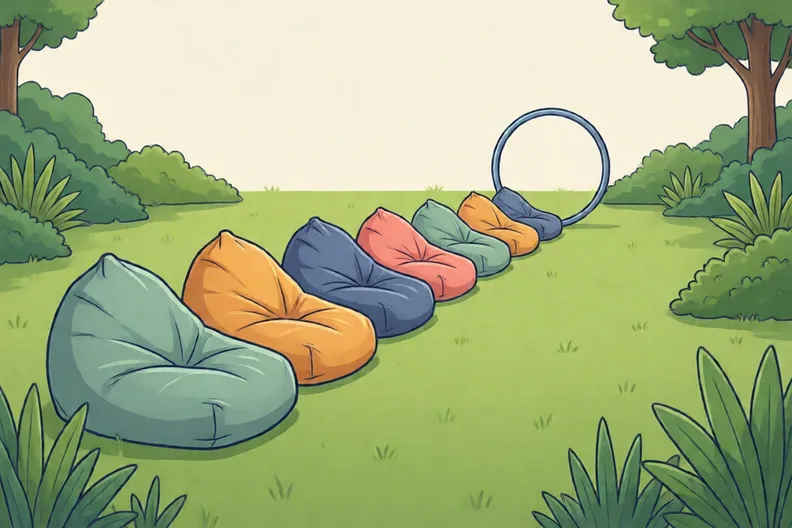
A flat garden lawn with a row of soft bean bags and a plastic hoop at the far end
Watch me
GoalRolesOne ruleMood plan

Ola's goal: every bean bag in the hoop.

She gives each cousin a job: pick up, or count.

Her one rule: throw underarm, so nobody gets hurt.

If a bag misses, she cheers and says try again.

Now you
  1. 1.

    Mia is leading a tidy-up relay. Put her four briefing steps in the same order as Ola's briefing. Write 1 to 4 in the boxes.

    1. Say how to keep the mood happy
    2. Say the goal
    3. Give each person a job
    4. Set one rule

C Your turn8 min

Clear space, a soft ball, away from windows, and a grown-up watching. Read each row, then answer.
A soft ball resting on a garden lawn beside a small orange cone
  1. 1.

    Ola is teaching her cousins to catch. Her first tip is to get in line with the ball. Put her four tips in order. Write 1 to 4 in the boxes.

    1. Watch the ball all the way into your hands
    2. Squeeze gently and bring it in
    3. Get your body in line with the ball
    4. Hold your hands out wide and ready
  2. 2.

    Join each leader action to what it looks like in the garden.

    Gives each person a jobKeeps the mood positiveAsks what others think
    Waits for ideas before decidingSays who will count the conesSmiles and cheers when a throw misses
  3. 3.

    A player keeps looking down at their feet while catching. Which coaching point helps most? Circle it.

    Watch the ballRun fasterShut your eyes
  4. 4.

    Give your grown-up a short briefing, then lead three 30-second catching tries. Colour one bar for each try to show how many catches you made.

    My catches in 30 seconds02468101214161820Try 1Try 2Try 3

Say it out loud: Which leader action from today helped your team most, and why?

D Spot the mistake3 min

A soft ball high in the air above a grass lawn
Ali says: “I am the leader, so I have all the ideas. Everyone else just does what I say.”
  1. 1.

    What should Ali do instead? Write one thing a good leader does.

E Think deeper4 min

Think about a leader you have seen in a team, at school or in a club.

Small coloured cones and soft balls laid out on a garden path
  1. 1.

    Name two things a good leader does so everyone has a part. Explain how you know each one helps.

How did it feel?2 min

Tell your grown-up one leader action you used today, and whether it helped the team.

I can do it Nearly Not yet
StudyDen · Year 6 · PE · Outdoor adventurous activities: leadershipAnswers are on the grown-up page

For the grown-up

Leading a team · 2 minutes to read

Answers, and what a wrong one tells you

A

1. Warm up your child may have picked a word that is not about getting ready. A warm-up always comes first, to get the muscles ready. Ask what the team does first in every session.

2. Throw 2 your child may have picked Throw 3, the last throw. A personal best is the best result, not the latest one. Ask which bar reaches highest.

3. Look your child may have picked a word that is not a safety check. The middle step is Look, so you see the space before you move. Ask what you need to see before you start a game.

B

1. 1 Say the goal · 2 Give each person a job · 3 Set one rule · 4 Say how to keep the mood happy your child may have put the mood step first. A briefing starts with the goal, so everyone knows what they are aiming for. Ask what Mia must tell the team before anything else.

C

1. 1 Get your body in line with the ball · 2 Hold your hands out wide and ready · 3 Watch the ball all the way into your hands · 4 Squeeze gently and bring it in your child may have put squeezing first. The hands must be ready before the ball arrives. Ask the child to act out the catch in slow motion, step by step.

2. Gives each person a job → Says who will count the cones; Keeps the mood positive → Smiles and cheers when a throw misses; Asks what others think → Waits for ideas before deciding

3. Watch the ball your child may have picked Run faster, which does not fix where the eyes go. The eyes must follow the ball. Ask what the player could see if they looked at the ball instead of the feet.

4. Look for: Three bars coloured, one for each try, showing how many catches were made in each try.

D

1. Look for: Says Ali should ask for and listen to other people's ideas, or give everyone a part, instead of deciding everything alone. your child may think the leader should decide everything. Ask how the cousins would feel if Ola never asked for their ideas.

E

1. Look for: Two leader actions, such as giving each person a role or listening to ideas, with a reason that it helps the team.

Words to use

Say“Ask them to give you their briefing first. What is the goal, and what job does each person have?”
Instead of“Tell them a leader is the one who makes all the decisions and everyone else follows.”

After the sheet

Clear space, a soft ball, away from windows, and a grown-up watching. Your child gives you a short briefing with a goal, a job for each person and one rule. Then they lead three 30-second catching tries while you write down the catches in each try.

Tick what your child got right in StudyDen. Anything missed comes back in a later Look back box, so there's no need to redo the sheet.

The rest of this unit

5 more sheets come with a StudyDen plan, in teaching order:

  1. Leading with voice and signals(with a plan)
  2. Why space changes everything(with a plan)
  3. Adapting the Task(with a plan)
  4. Organising People(with a plan)
  5. One change, then watch(with a plan)

Every Year 6 PE worksheet

The worksheets plan opens a printable sheet for every lesson in Years 1 to 6, each with its answers on a separate page for you. It costs £6.99 a month or £59 a year for the whole family, with no free trial.

The full StudyDen plan adds the lessons themselves, marked as your child works, with the worksheets included. It is 7 days free, then £29.99 a month.

Both start with a free account; you choose the plan when you sign up.