← Year 1 English worksheets

Year 1 Writing lower case letters in print worksheet

“Ready to write” is free to print, with no account. It is the first sheet in the Year 1 English unit “Writing lower case letters in print”, for children aged 5 to 6, and takes about 20 minutes.

Print it on A4. The child's pages come first; the answers, and what each wrong answer tells you, are on the grown-up page that follows. Weeks 4 to 7 of the year, 13 sheets in the unit.

Free sample · answers on the last page

Ready to write

Name: ____________ · Date: ____________
Year 1 · English · about 20 minutes
Answers are on the grown-up page

Today I can sit and hold my pencil ready before I write.

A Look back3 min

  1. 1.

    Which letter comes after d in the alphabet? Circle one.

    cd
    efc
  2. 2.

    One more than 6 is

  3. 3.

    15 9

    159

B Watch me, then you4 min

Ola is going to write a line of letters. She gets her body and hands ready first.

Watch me
Sit readyHold pencilStart writing

First, Ola sits with her feet flat on the floor.

Next, she holds her pencil in a tripod grip.

Then she starts her line at the top of the page.

Now you
  1. 1.

    Bea wants to draw lines. Number the steps in the right order: 1, 2, 3.

    1. Hold the pencil in a tripod grip
    2. Start the first line at the top
    3. Sit with feet flat on the floor

C Your turn6 min

Look at the pictures, then answer each row. Each row changes one thing.
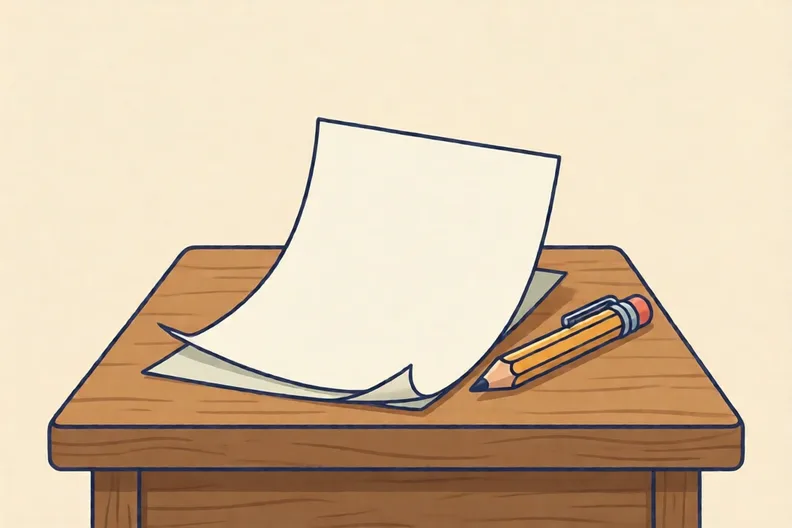
A sheet of plain paper tilted slightly on a wooden table, with a sharp pencil lying beside it
  1. 1.

    A right-handed writer tilts the paper which way? Circle one.

    a little to the lefta little to the rightflat and straight
  2. 2.

    A left-handed writer tilts the paper which way? Circle one.

    a little to the lefta little to the rightflat and straight
  3. 3.

    Put each letter in the column that matches how it starts.

    cial
    Starts with a curveStarts with a line down
  4. 4.

    Put each letter in the column that matches how it starts.

    ohdt
    Starts with a curveStarts with a line down

Say it out loud: Which hand do you write with? Does the paper tilt the same way for you?

D Spot the mistake3 min
A pencil and a sheet of paper on a desk next to a small pot of pencils
Ali says: “Hold your pencil in a tight fist so it cannot slip.”
  1. 1.

    Is Ali right? Circle the better way to hold a pencil.

    a tight fistpinch it with thumb and pointing fingerhold it with the whole hand

E Think deeper4 min
A blank open notebook and pencil on a table with a chair pulled up to it.
  1. 1.

    Why does sitting well help your writing? Write one or two sentences. Tell your grown-up.

How did it feel?

I can do it Nearly Not yet
StudyDen · Year 1 · English · Writing lower case letters in printAnswers are on the grown-up page

For the grown-up

Ready to write · 2 minutes to read

Answers, and what a wrong one tells you

A

1. e

2. 7

3. >

B

1. 1 Sit with feet flat on the floor · 2 Hold the pencil in a tripod grip · 3 Start the first line at the top If your child puts writing first, the body and hands are not ready yet. Ask what Bea should do before she picks up the pencil.

C

1. a little to the left If your child chooses flat and straight, the paper is not tilted. A right-handed writer tilts the paper a little to the left.

2. a little to the right If your child circles to the left, they have used the right-hand rule. A left-handed writer tilts the paper the other way.

3. Starts with a curve: c, a · Starts with a line down: i, l If your child puts i or l with the curves, ask them to trace the letter with a finger and say where it starts.

4. Starts with a curve: o, d · Starts with a line down: h, t If your child places h with the curves, ask whether h starts with a curve or a straight line going down.

D

1. pinch it with thumb and pointing finger If your child circles the tight fist, they think tighter is better. A tripod grip is a light pinch between thumb and pointing finger, resting on the tall finger.

E

1. Look for: A sentence giving a reason, such as the hand can move more easily, the body stays steady, or the paper stays still.

Words to use

Say“Show me how you sit. Are your feet flat and your back against the chair?”
Instead of“Hurry up and start writing. You can fix your sitting later.”

After the sheet

Set up a writing spot at home. Sit at a table with the paper tilted, then draw five wiggly lines and five loops with a pencil held in a tripod grip.

Tick what your child got right in StudyDen. Anything missed comes back in a later Look back box, so there's no need to redo the sheet.

The rest of this unit

12 more sheets come with a StudyDen plan, in teaching order:

  1. Writing i, l and t(with a plan)
  2. Writing u, y and j(with a plan)
  3. Secret relatives: m, n, r(with a plan)
  4. Writing h and k(with a plan)
  5. Forming b and p(with a plan)
  6. Writing c, a and d(with a plan)
  7. Round and round: o, g, q(with a plan)
  8. Curly e, s and f(with a plan)
  9. Small letters v, w, x and z(with a plan)
  10. Small letters, same height(with a plan)
  11. Tails that dip down(with a plan)
  12. Tall letter practice(with a plan)

Every Year 1 English worksheet

The worksheets plan opens a printable sheet for every lesson in Years 1 to 6, each with its answers on a separate page for you. It costs £6.99 a month or £59 a year for the whole family, with no free trial.

The full StudyDen plan adds the lessons themselves, marked as your child works, with the worksheets included. It is 7 days free, then £29.99 a month.

Both start with a free account; you choose the plan when you sign up.