← Year 6 science worksheets

Year 6 Changing circuits worksheet

“Parts of a circuit” is free to print, with no account. It is the first sheet in the Year 6 science unit “Changing circuits”, for children aged 10 to 11, and takes about 20 minutes.

Print it on A4. The child's pages come first; the answers, and what each wrong answer tells you, are on the grown-up page that follows. Weeks 3 to 8 of the year, 16 sheets in the unit.

Free sample · answers on the last page

Parts of a circuit

Name: ____________ · Date: ____________
Year 6 · Science · about 20 minutes
Answers are on the grown-up page

Today I can name the parts of a simple circuit and say how adding a cell changes them.

A Look back3 min

  1. 1.

    Which part goes in the empty box to make this loop give light? Circle it.

    cellwirewire
    cellbuzzerbulb
  2. 2.

    The switch in this loop is open. Will the bulb be lit? Circle the answer.

    cellswitch openbulbwire
    Yes, it stays lit.No, it goes out.It gets brighter.
  3. 3.

    Which word means a complete loop that electricity can flow around?

    cellbulbwire
    circuitterminalswitch

B Watch me, then you4 min

Ola builds a torch. She joins one cell, one bulb and two wires into a loop.

Watch me
cellwirebulbwire

Follow the loop with your finger: cell, wire, bulb, wire, and back to the cell.

Every join touches, so there is no gap.

The bulb lights because electricity can flow all the way round.

Now you
  1. 1.

    Leo wants a loop that makes a sound. Which card goes in the empty box?

    cellwirewire
    bulbbuzzerswitch
  2. 2.

    Kit wants this loop to make something spin. Which card goes in the empty box?

    cellwireswitchwire
    motorbuzzerbulbswitch

C Your turn6 min

Each question says what happens to one part. Circle the component it describes.
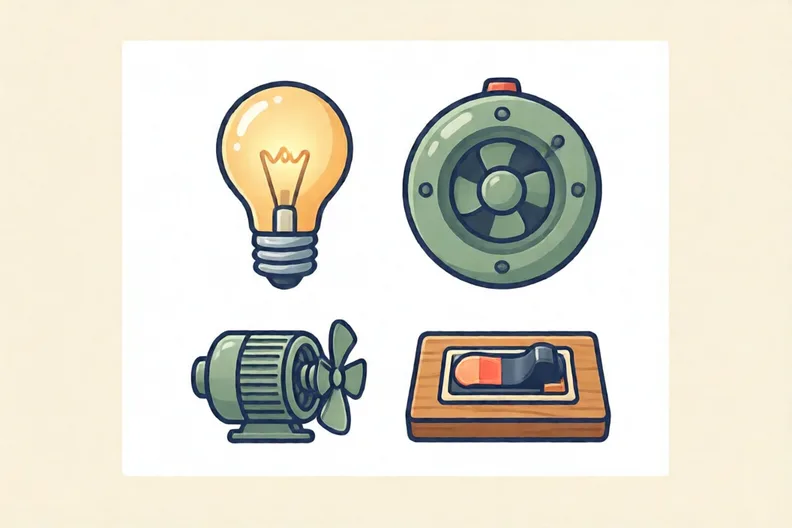
A light bulb, a buzzer, a small motor and a slide switch on a plain background.
  1. 1.

    Ola adds a second cell to her loop. Which part now glows more brightly? Circle one.

    bulbbuzzermotorswitch
  2. 2.

    Leo adds a second cell to his loop. Which part now sounds louder? Circle one.

    bulbbuzzermotorswitch
  3. 3.

    Kit adds a second cell to the loop. Which part now spins faster? Circle one.

    bulbbuzzermotorswitch
  4. 4.

    Which part can break the loop without cutting a wire, so every other part stops? Circle one.

    bulbbuzzermotorswitch

Say it out loud: What did adding a cell do to each part? Which part works the same way however many cells there are?

D Spot the mistake3 min

Kit says: “The cell is like a tank full of electricity. When I cut the wire, the bulb stays lit until the tank runs dry.”
cellwirebulbcut wire
  1. 1.

    What really happens to the bulb when the wire is cut? Circle one.

    It stays lit until the cell runs out.It goes out straight away.It glows dimmer near the cut.

E Think deeper3 min

  1. 1.

    Ali's loop has a cell, a bulb, a buzzer and a switch. Ali opens the switch and says the buzzer stops but the bulb stays lit. Is Ali right? Explain how you know.

    cellbulbbuzzerswitchwire

How did it feel?

I can do it Nearly Not yet
StudyDen · Year 6 · Science · Changing circuitsAnswers are on the grown-up page

For the grown-up

Parts of a circuit · 2 minutes to read

Answers, and what a wrong one tells you

A

1. bulb your child may have picked the buzzer. A buzzer makes sound, not light. Ask: which part glows when the electricity flows?

2. No, it goes out. If your child says the bulb stays lit, ask: is the loop still joined all the way round? An open switch leaves a gap, so the bulb goes out.

3. circuit

B

1. buzzer your child may have picked the bulb. A bulb gives light, but the question asks for sound. Ask what the buzzer does.

2. motor

C

1. bulb your child may have picked the buzzer. A buzzer gets louder with more cells, but it does not glow. Ask which part gives light.

2. buzzer your child may have picked the motor. More cells make a motor spin faster, but the buzzer makes the sound.

3. motor

4. switch

D

1. It goes out straight away. your child may think the cell holds electricity like a tank. Cutting the loop stops the flow at once. Ask: is the loop still joined all the way round?

E

1. Look for: Says no, because the open switch breaks the single loop, so the flow stops everywhere and both the bulb and the buzzer go off.

Words to use

Say“Which part of the loop is the gap? What does that part do?”
Instead of“Tell them the answer straight away.”

After the sheet

Build a loop at home with a battery, a torch bulb and two pieces of wire or foil. Make the bulb light, then open the loop and say what happens.

Tick what your child got right in StudyDen. Anything missed comes back in a later Look back box, so there's no need to redo the sheet.

The rest of this unit

15 more sheets come with a StudyDen plan, in teaching order:

  1. Drawing circuits with symbols(with a plan)
  2. Found or made?(with a plan)
  3. Planning a voltage test(with a plan)
  4. Cells and bulb brightness(with a plan)
  5. Planning a fair circuit test(with a plan)
  6. Changing one thing at a time(with a plan)
  7. Buzzers and loud sounds(with a plan)
  8. Switches: open and closed(with a plan)
  9. Conductors and insulators(with a plan)
  10. Keeping electricity on its path(with a plan)
  11. Jobs that use electricity(with a plan)
  12. Designing a water sensor(with a plan)
  13. Make and review your sensor(with a plan)
  14. Debating electric cars(with a plan)
  15. Sustainable sources of electricity(with a plan)

Every Year 6 science worksheet

The worksheets plan opens a printable sheet for every lesson in Years 1 to 6, each with its answers on a separate page for you. It costs £6.99 a month or £59 a year for the whole family, with no free trial.

The full StudyDen plan adds the lessons themselves, marked as your child works, with the worksheets included. It is 7 days free, then £29.99 a month.

Both start with a free account; you choose the plan when you sign up.