← Year 6 science worksheets

Year 6 Light and how it travels worksheet

“How light travels” is free to print, with no account. It is the first sheet in the Year 6 science unit “Light and how it travels”, for children aged 10 to 11, and takes about 20 minutes.

Print it on A4. The child's pages come first; the answers, and what each wrong answer tells you, are on the grown-up page that follows. Weeks 26 to 31 of the year, 11 sheets in the unit.

Free sample · answers on the last page

How light travels

Name: ____________ · Date: ____________
Year 6 · Science · about 20 minutes
Answers are on the grown-up page

Today I can explain that light travels in straight lines and show its path.

A Look back3 min

  1. 1.

    The arrows point to the eater. Which animal eats the rabbit? Circle one.

    GrassRabbit
    foxgrassrabbit
  2. 2.

    Water vapour cools and forms tiny drops again. Which word fits the blank? Circle one.

    EvaporationPrecipitationCollection
    CondensationEvaporationMelting
  3. 3.

    Which day had the most rain? Circle one.

    Millimetres of rain last week0123456MondayTuesdayWednesday
    MondayTuesdayWednesday

B Watch me, then you4 min

Sam shines a torch through three cards. Each card has a small hole. The holes are lined up in a straight line. Does the light reach the wall?
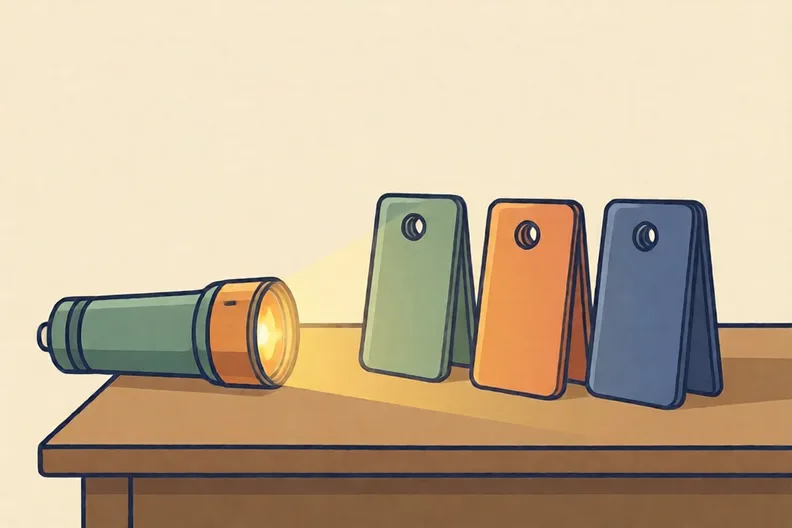
A torch on a table shining towards three upright cards, each with a small hole.
Watch me
TorchCard 1Card 2Card 3Wall

The three holes are lined up in a straight line.

Light passes through all three holes and reaches the wall.

Light travels in straight lines, so it can reach the wall.

Now you
  1. 1.

    Sam moves the middle card sideways, so the holes no longer line up. Does light still reach the wall? Circle one.

    TorchCard 1Card 2 (moved)Card 3Wall
    yesno

C Your turn6 min

Each row changes one thing. Read the row, then circle yes or no.
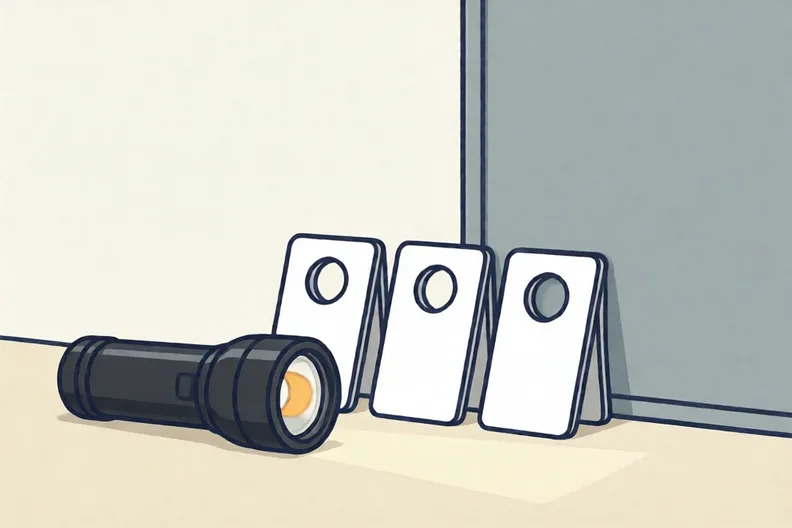
A torch, three cards with holes and a wall, set in a straight row on a table.
  1. 1.

    Cards 1 and 2 line up, but the hole in Card 3 is much higher than the other two holes. Does light reach the wall? Circle one.

    yesno
  2. 2.

    The holes line up, but Card 2 is swapped for a sheet of clear plastic with no hole. Does light reach the wall? Circle one.

    yesno
  3. 3.

    The holes line up again, but kitchen foil is taped over the hole in Card 3. Does light reach the wall? Circle one.

    yesno
  4. 4.

    The holes are lined up again, but the wall is much further from the torch. Does light reach the wall? Circle one.

    TorchCard 1Card 2Card 3Far wall
    yesno

Say it out loud: What did you change in this row? What stayed the same, and did the answer change?

D Spot the mistake3 min

Kit says: “Light can bend round a card, so it still reaches the wall when the holes do not line up.”
TorchCard 1Card 2 (out of line)Wall
  1. 1.

    Is Kit right? Circle one. Then tell a grown-up why, using the words straight line.

    yesno

E Think deeper3 min

  1. 1.

    The picture shows light going from a torch to a mug. Explain why we draw this path as a straight line with the arrow pointing to the mug. Write 2 to 3 lines.

    TorchMug

How did it feel?

I can do it Nearly Not yet
StudyDen · Year 6 · Science · Light and how it travelsAnswers are on the grown-up page

For the grown-up

How light travels · 2 minutes to read

Answers, and what a wrong one tells you

A

1. fox If your child circles grass, the arrows may be read the wrong way. The arrow points from the food to the eater. Trace the arrow from the rabbit.

2. Condensation If your child circles evaporation, they have the wrong direction. Evaporation turns liquid water into vapour. Ask what the vapour does when it cools.

3. Tuesday If your child circles Monday, they may have read the first bar. Ask them to run a finger along the tallest bar.

B

1. no If your child circles yes, they think light can bend round the card. Light travels in straight lines, so the card blocks it. Let them try it with two cards.

C

1. no If your child circles yes, ask them to trace a straight line from the torch. Does it hit the hole in Card 3, or the card?

2. yes If your child circles no, ask whether light can pass through clear plastic, like a window. Nothing blocks the straight path.

3. no If your child circles yes, ask whether light can pass through foil. Foil blocks the straight path, so no light reaches the wall.

4. yes

D

1. no If your child circles yes, they think light can curve. Move one card out of line with a torch and ask where the light went.

E

1. Look for: Says light travels in straight lines, and the arrow points to the mug because light leaves the torch and travels to it.

Words to use

Say“Show me with your finger where the light goes from the torch. Did it bend anywhere?”
Instead of“Light just comes out of the torch, so it obviously reaches the wall.”

After the sheet

Use a torch, two or three cards and a pencil. Make a small hole in each card, line the holes up, shine the torch through, then move one card and watch the light stop.

Tick what your child got right in StudyDen. Anything missed comes back in a later Look back box, so there's no need to redo the sheet.

The rest of this unit

10 more sheets come with a StudyDen plan, in teaching order:

  1. Light sources and reflectors(with a plan)
  2. How light reaches our eyes(with a plan)
  3. How light lets us see(with a plan)
  4. Bouncing light round corners(with a plan)
  5. Planning a fair torch test(with a plan)
  6. Measuring reflected light(with a plan)
  7. How shadows form(with a plan)
  8. Shadow shape tests(with a plan)
  9. Where shadows fall(with a plan)
  10. Many shadows, one object(with a plan)

Every Year 6 science worksheet

The worksheets plan opens a printable sheet for every lesson in Years 1 to 6, each with its answers on a separate page for you. It costs £6.99 a month or £59 a year for the whole family, with no free trial.

The full StudyDen plan adds the lessons themselves, marked as your child works, with the worksheets included. It is 7 days free, then £29.99 a month.

Both start with a free account; you choose the plan when you sign up.