← Year 5 maths worksheets

Year 5 Multiplication by partitioning leading to short multiplication (3 by 1-digit) worksheet

“Splitting to multiply” is free to print, with no account. It is the first sheet in the Year 5 maths unit “Multiplication by partitioning leading to short multiplication (3 by 1-digit)”, for children aged 9 to 10, and takes about 20 minutes.

Print it on A4. The child's pages come first; the answers, and what each wrong answer tells you, are on the grown-up page that follows. Week 9 of the year, 5 sheets in the unit.

Free sample · answers on the last page

Splitting to multiply

Name: ____________ · Date: ____________
Year 5 · Maths · about 20 minutes
Answers are on the grown-up page

Today I can multiply a 3-digit number by a 1-digit number by splitting it into hundreds, tens and ones.

A Look back3 min

  1. 1.

    3 × 4 =

  2. 2.

    70 + 70 + 70 =

    707070
  3. 3.

    6 × 10 =

B Watch me, then you4 min

A bakery puts 132 buns on each tray. It bakes 4 trays. How many buns in all?
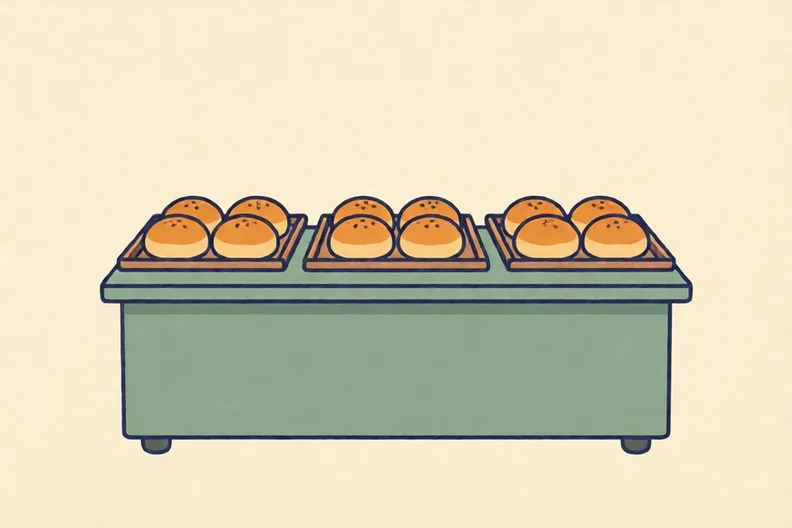
A bakery counter with round buns laid out on trays
Watch me
132100302

132 is 100 + 30 + 2.

4 × 100 = 400, 4 × 30 = 120 and 4 × 2 = 8.

400 + 120 + 8 = 528, so 4 × 132 = 528.

Now you
  1. 1.

    A shop has 3 boxes with 124 pencils in each. How many pencils in all?

    124

C Your turn6 min

Split each number into hundreds, tens and ones first. Then multiply each part.

  1. 1.

    Work out 2 × 143.

    143
  2. 2.

    Work out 2 × 183.

    183
  3. 3.

    Work out 2 × 203.

    203
  4. 4.

    Work out 4 × 203.

    203

Say it out loud: What changed from one row to the next, and what stayed the same?

D Spot the mistake3 min

Kit says: “The 2 in 124 is only 2, so 4 × 124 = 4 × 1 + 4 × 2 + 4 × 4 = 28.”
124
  1. 1.

    What is 4 × 124?

E Think deeper3 min

330300
  1. 1.

    Which whole numbers from 100 to 200, when multiplied by 3, give a product from 300 to 330? Write them all.

How did it feel?

I can do it Nearly Not yet
StudyDen · Year 5 · Maths · Multiplication by partitioning leading to short multiplication (3 by 1-digit)Answers are on the grown-up page

For the grown-up

Splitting to multiply · 2 minutes to read

Answers, and what a wrong one tells you

A

1. 12

2. 210

3. 60

B

1. 372

C

1. 286

2. 366 If your child gets a number close to 366 but not quite, check each partial product: 2 × 100, 2 × 80 and 2 × 3.

3. 406 If your child writes 46, the hundreds have gone missing, so 203 was treated as 23. The 2 is 2 hundreds, which is 200. Keep the 200 and the 0 tens in the split.

4. 812

D

1. 496 If your child writes 28, the digits were treated as face values. The 1 is worth 100 and the 2 is worth 20, so the sum is 4 × 100 + 4 × 20 + 4 × 4.

E

1. 100, 101, 102, 103, 104, 105, 106, 107, 108, 109, 110

Words to use

Say“Which digit is this, and what place is it in? What is it worth?”
Instead of“Just multiply the first digit and ignore the rest.”

After the sheet

Write three 3-digit numbers on slips of paper. Pick one, split it into hundreds, tens and ones on the table, and multiply each part by 2 or 3.

Tick what your child got right in StudyDen. Anything missed comes back in a later Look back box, so there's no need to redo the sheet.

The rest of this unit

4 more sheets come with a StudyDen plan, in teaching order:

  1. Multiplying without regrouping(with a plan)
  2. Regrouping in multiplication(with a plan)
  3. Multiplying with several regroups(with a plan)
  4. Estimate before you calculate(with a plan)

Every Year 5 maths worksheet

The worksheets plan opens a printable sheet for every lesson in Years 1 to 6, each with its answers on a separate page for you. It costs £6.99 a month or £59 a year for the whole family, with no free trial.

The full StudyDen plan adds the lessons themselves, marked as your child works, with the worksheets included. It is 7 days free, then £29.99 a month.

Both start with a free account; you choose the plan when you sign up.