← Year 5 maths worksheets

Year 5 Multiply 3 or more numbers (commutative and associative laws) worksheet

“Multiply in any order” is free to print, with no account. It is the first sheet in the Year 5 maths unit “Multiply 3 or more numbers (commutative and associative laws)”, for children aged 9 to 10, and takes about 20 minutes.

Print it on A4. The child's pages come first; the answers, and what each wrong answer tells you, are on the grown-up page that follows. Week 22 of the year, 5 sheets in the unit.

Free sample · answers on the last page

Multiply in any order

Name: ____________ · Date: ____________
Year 5 · Maths · about 20 minutes
Answers are on the grown-up page

Today I can multiply three numbers by working out the easiest pair first.

A Look back3 min

  1. 1.

    6 × 4 =

  2. 2.

    9 × 3 =

  3. 3.

    List every factor of 12 that is not 1 or 12.

B Watch me, then you4 min

A shelf holds 2 egg trays. Each tray has 4 rows of 5 eggs. How many eggs are on the shelf?
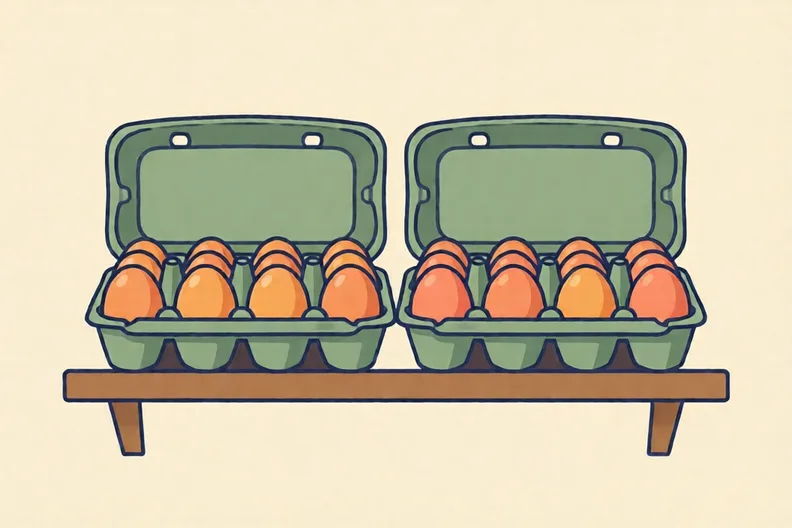
A tidy shelf holding two cardboard egg trays side by side
Watch me

Pick the easy pair first: 4 × 5 = 20.

Then 2 × 20 = 40.

So 2 × 4 × 5 = 40.

Now you
  1. 1.

    3 × 6 × 2 =

C Your turn6 min

Work out each one. Choose the easiest pair to multiply first.

  1. 1.

    4 × 5 × 2 =

  2. 2.

    2 × 4 × 5 =

  3. 3.

    5 × 2 × 3 =

  4. 4.

    2 × 5 × 7 =

Say it out loud: Which pair did you multiply first, and why was it the easy one?

D Spot the mistake3 min

Ali says: “5 × 2 × 4 gives a different answer from 4 × 5 × 2, so one of them must be wrong.”
  1. 1.

    Work out 4 × 5 × 2.

E Think deeper4 min

Choose the easiest pair to multiply first, then explain your choice.

  1. 1.

    Sam works out 7 × 5 × 4 from left to right, starting with 35 × 4. Find an easier pair to multiply first. Explain why it is easier and give the answer.

How did it feel?

I can do it Nearly Not yet
StudyDen · Year 5 · Maths · Multiply 3 or more numbers (commutative and associative laws)Answers are on the grown-up page

For the grown-up

Multiply in any order · 2 minutes to read

Answers, and what a wrong one tells you

A

1. 24

2. 27

3. 2, 3, 4, 6

B

1. 36 If your child writes 12, they multiplied only the last two numbers and dropped the 3. Ask: which numbers are being multiplied?

C

1. 40 If your child writes 20, they multiplied 4 × 5 and forgot the 2. Ask: is there one more factor to use?

2. 40

3. 30

4. 70

D

1. 40 If your child writes 20, they stopped after 4 × 5 and missed the last factor, 2. Both orders use all three numbers and give 40.

E

1. Look for: 140, found by multiplying 5 × 4 = 20 first and then 7 × 20, with a reason such as multiplying by 20 being easier than 35 × 4. If your child keeps 35 × 4, ask which two numbers multiply to make a multiple of 10. 5 × 4 = 20, and 7 × 20 is quick.

Words to use

Say“Which pair is the easiest to multiply first?”
Instead of“Always work from left to right.”

After the sheet

Make 2 piles of buttons, each set out as 4 rows of 5. Count them as 2 × 4 first, then as 4 × 5 first, and check both totals match.

Tick what your child got right in StudyDen. Anything missed comes back in a later Look back box, so there's no need to redo the sheet.

The rest of this unit

4 more sheets come with a StudyDen plan, in teaching order:

  1. Pairs that make tidy numbers(with a plan)
  2. Splitting factors to make friendly numbers(with a plan)
  3. Quick volume with pairs(with a plan)
  4. Rearrange to make it easy(with a plan)

Every Year 5 maths worksheet

The worksheets plan opens a printable sheet for every lesson in Years 1 to 6, each with its answers on a separate page for you. It costs £6.99 a month or £59 a year for the whole family, with no free trial.

The full StudyDen plan adds the lessons themselves, marked as your child works, with the worksheets included. It is 7 days free, then £29.99 a month.

Both start with a free account; you choose the plan when you sign up.