← Year 5 maths worksheets

Year 5 Understand the concept of volume worksheet

“What takes up space” is free to print, with no account. It is the first sheet in the Year 5 maths unit “Understand the concept of volume”, for children aged 9 to 10, and takes about 20 minutes.

Print it on A4. The child's pages come first; the answers, and what each wrong answer tells you, are on the grown-up page that follows. Week 21 of the year, 5 sheets in the unit.

Free sample · answers on the last page

What takes up space

Name: ____________ · Date: ____________
Year 5 · Maths · about 20 minutes
Answers are on the grown-up page

Today I can explain what volume is and why a tall object does not always have the greatest volume.

A Look back3 min

  1. 1.

    4 rows with 6 squares in each row make squares altogether.

  2. 2.

    Put the correct sign in the box: 452 425

    452425
  3. 3.

    1 cube has 6 faces. 3 cubes have faces altogether.

B Watch me, then you4 min

Volume is how much space something takes up. Ola has 8 cubes. She makes a flat layer, then rebuilds the same 8 cubes into a tall tower. Which one has more cubes?

Watch me

Ola's flat layer has 2 rows of 4 cubes. That is 8 cubes.

She stacks the same 8 cubes into a tall tower.

The tower still has 8 cubes, so the two shapes have the same volume.

Now you
  1. 1.

    Kit has one flat layer of 3 rows with 4 cubes in each row. He rebuilds all of them into a tall tower. How many cubes are in the tower?

C Your turn5 min

Each flat layer is a set of rows. Count all the cubes in the layer.

  1. 1.

    A layer has 2 rows with 3 cubes in each row. It has cubes.

  2. 2.

    A layer has 2 rows with 5 cubes in each row. It has cubes.

  3. 3.

    A layer has 4 rows with 5 cubes in each row. It has cubes.

  4. 4.

    Mia's flat layer has 4 rows with 5 cubes in each row. She stacks all of them into a tall, thin tower. How many cubes does the tower have?

Say it out loud: When the rows got longer, what changed? When the shape changed to a tower, did the number of cubes change?

D Spot the mistake2 min

Ben says: “The tower is taller than the flat block, so it must have more cubes. I think it has 15.”
  1. 1.

    The flat block has 3 rows of 4 cubes. The tower is made from the same cubes. How many cubes are in the tower?

E Think deeper3 min

Ruby builds a flat block from 24 cubes. Tom builds a tall tower from 20 cubes of the same size.
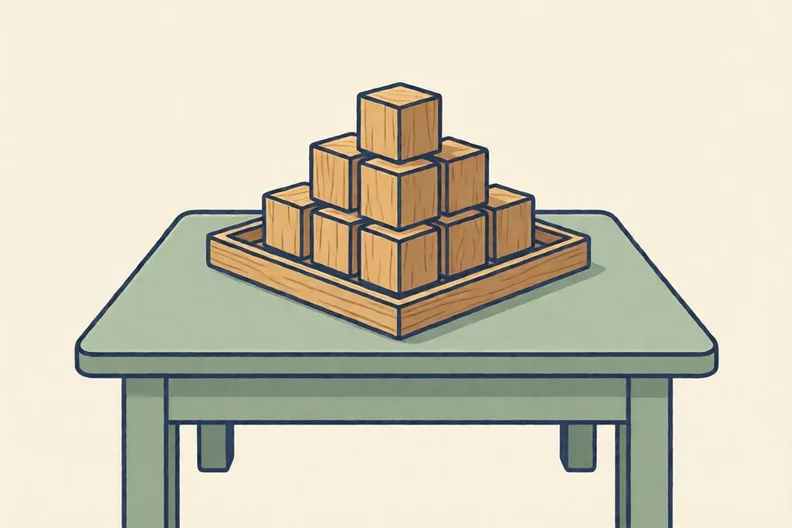
A kitchen table with a flat tray holding a neat pile of plain wooden cubes
  1. 1.

    Tom says his tower takes up more space because it is taller. Which shape takes up more space? Explain how you know.

How did it feel?

I can do it Nearly Not yet
StudyDen · Year 5 · Maths · Understand the concept of volumeAnswers are on the grown-up page

For the grown-up

What takes up space · 2 minutes to read

Answers, and what a wrong one tells you

A

1. 24 If your child writes 10, they added 4 and 6 instead of counting 4 rows of 6. Multiply the rows by the number in each row.

2. >

3. 18

B

1. 12 If your child writes 7, they added 3 and 4 instead of multiplying. Count every cube in the layer, then keep that total for the tower.

C

1. 6 If your child writes 5, they added 2 and 3 instead of multiplying. Count the rows, then the cubes in each row.

2. 10

3. 20

4. 20

D

1. 12 Being taller does not add cubes. Ask your child whether any cube was added when the block became a tower. Both shapes use the same 12 cubes.

E

1. Look for: Ruby's block, because 24 cubes is more than 20 cubes, with a reason that counts cubes rather than height. If your child picks Tom's tower, ask how many cubes each shape has. More cubes of the same size take up more space, whatever the height.

Words to use

Say“Did the number of cubes change, or only the shape? How do you know?”
Instead of“Taller always means more, so the tower must be bigger.”

After the sheet

Line up 12 dice or sugar cubes in a flat block, then stack them into a tall tower. Count each one and compare.

Tick what your child got right in StudyDen. Anything missed comes back in a later Look back box, so there's no need to redo the sheet.

The rest of this unit

4 more sheets come with a StudyDen plan, in teaching order:

  1. Units for volume(with a plan)
  2. Volume of cuboids and cubes(with a plan)
  3. Volume of compound shapes(with a plan)
  4. Finding missing lengths(with a plan)

Every Year 5 maths worksheet

The worksheets plan opens a printable sheet for every lesson in Years 1 to 6, each with its answers on a separate page for you. It costs £6.99 a month or £59 a year for the whole family, with no free trial.

The full StudyDen plan adds the lessons themselves, marked as your child works, with the worksheets included. It is 7 days free, then £29.99 a month.

Both start with a free account; you choose the plan when you sign up.