The first join
Today I can make the first join in one smooth stroke, with my pencil on the page.
A Look back3 min
- 1.
Which way does the letter c curve when you write it? Circle one.
anticlockwiseclockwise - 2.
Join each handwriting tip to its reason.
Hold the pencil looselyKeep the paper straightKeeps your lines levelStops the hand getting tired - 3.
Put these steps for the letter o in order. Write 1, 2 or 3 in each box.
- Curve round to the left
- Close where you started
- Start near the top right
B Watch me, then you4 min
Look at the pair an. The first join is the stroke between the a and the n.
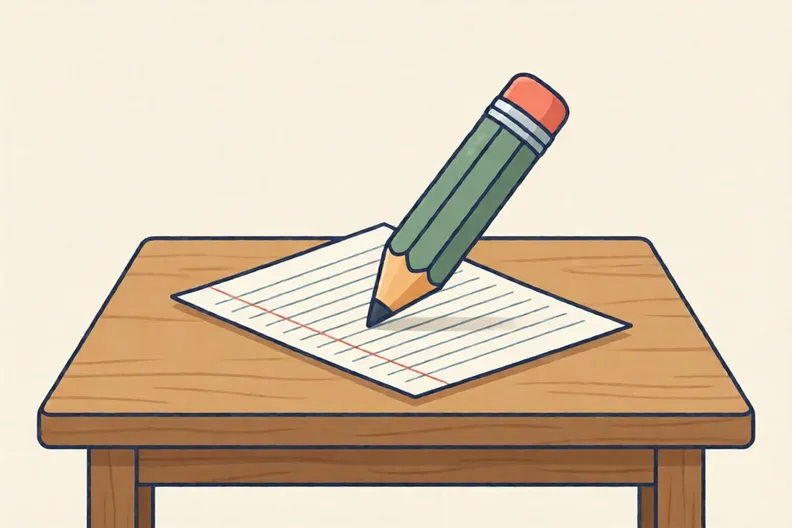
The a finishes on the baseline.
The join sweeps up to the x-height line.
The n starts there, and the pencil never lifts.
- 1.
In the pair ig, where does the join start? Circle one.
baselinex-height linetop line
C Your turn8 min
Look at each pair. Answer about the first join.
- 1.
In the pair ed, where does the join start? Circle one.
baselinex-height linetop line - 2.
In the pair ed, where does the join finish? Circle one.
baselinex-height linetop line - 3.
In the pair ar, where does the join finish? Circle one.
baselinex-height linetop line - 4.
Write the word tin on lined paper. Make the join between i and n in one smooth stroke. Tell your grown-up where it starts.
Say it out loud: What stayed the same in every row? What changed each time?
D Spot the mistake3 min
- 1.
What should Kit do instead? Write one sentence.
E Think deeper4 min
- 1.
On lined paper, write a short sentence using one pair from this sheet. Keep your pencil on the page for the join. Then tell your grown-up where the join starts and why.