← Year 6 English worksheets

Year 6 Building fluency with note taking, choice, quotations and emphasis worksheet

“Fast notes you can read” is free to print, with no account. It is the first sheet in the Year 6 English unit “Building fluency with note taking, choice, quotations and emphasis”, for children aged 10 to 11, and takes about 20 minutes.

Print it on A4. The child's pages come first; the answers, and what each wrong answer tells you, are on the grown-up page that follows. Weeks 13 to 14 of the year, 6 sheets in the unit.

Free sample · answers on the last page

Fast notes you can read

Name: ____________ · Date: ____________
Year 6 · English · about 20 minutes
Answers are on the grown-up page

Today I can keep my notes fast enough, accurate enough and legible enough to read back.

A Look back3 min

  1. 1.

    Look at the cycle. Circle the word for the empty box.

    PlanDraftPublish
    EditPlanColour in
  2. 2.

    In the sentence “The tall boy ran to the shop.” how many nouns are there?

    nounsverbsadjectives
  3. 3.

    How many syllables are in the word “computer”?

    computersyllables

B Watch me, then you4 min

Mia takes notes on a talk about rivers. She writes so fast that her letters start to wobble.

Watch me
HurryLetters wobbleRead backSlow a little

Mia writes so fast that her letters wobble.

She cannot read her notes back, so the speed did not help.

She reads back as she writes and slows a little. Her notes are readable again.

Now you
  1. 1.

    Sam writes fast and some words are hard to read. Circle the step for the empty box.

    Write fastWords hard to readNotes useful
    Check and read backStop taking notesCopy every word
  2. 2.

    Look at the bars. WWII is quicker to write than World War II. Why can you still read WWII back later? Write your answer on the lines.

    Characters written, counting spaces024681012World War IIWWII

C Your turn6 min

Each row is a different writing task. Circle joined writing or print letters for the task.
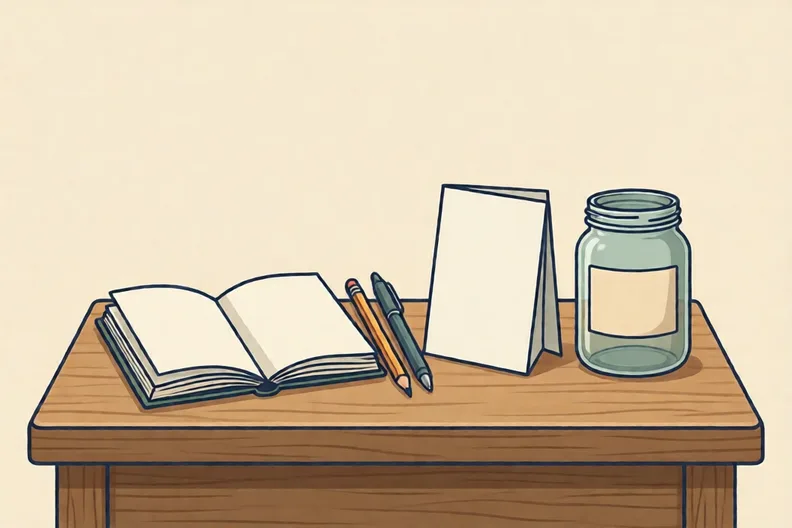
A wooden kitchen table with a notebook, pencil, pen, folded card and empty jar.
  1. 1.

    Taking fast notes in a science talk. Circle the best choice.

    joinedprint
  2. 2.

    A title on a poster for the classroom wall. Circle the best choice.

    joinedprint
  3. 3.

    A quick list of things to remember for later. Circle the best choice.

    joinedprint
  4. 4.

    A label on a jar that anyone in the kitchen must read. Circle the best choice.

    joinedprint

Say it out loud: Which word in each row told you the answer: quickly, or read by someone? What changed from row to row?

D Spot the mistake3 min
A school hall with rows of chairs and a speaker at a lectern, seen from the back
Kit says: “The fastest writer always makes the best notes.”
  1. 1.

    Write why Kit is wrong, in one or two sentences.

E Think deeper4 min

  1. 1.

    Write two sentences. Explain why a good note-taker needs speed, accuracy and legibility, not just speed.

    SpeedAccuracyLegibility

How did it feel?

I can do it Nearly Not yet
StudyDen · Year 6 · English · Building fluency with note taking, choice, quotations and emphasisAnswers are on the grown-up page

For the grown-up

Fast notes you can read · 2 minutes to read

Answers, and what a wrong one tells you

A

1. Edit your child may have picked Plan, which comes before drafting. Ask: what do writers do to a draft before it is final?

2. 2

3. 3

B

1. Check and read back

2. Look for: A reason such as WWII is a well-known short form, so the meaning stays clear when the notes are read back.

C

1. joined

2. print

3. joined

4. print

D

1. Look for: Speed alone does not make good notes; notes must be legible and useful to read back later. your child may have repeated the claim. Ask: could you read the fastest notes you ever wrote tomorrow? Then ask what makes notes useful.

E

1. Look for: Two sentences linking speed with legibility or accuracy, such as fast notes that cannot be read are useless.

Words to use

Say“Read one line back to me. Could you read it tomorrow without guessing?”
Instead of“Just write faster and do not worry about how neat it is.”

After the sheet

Ask them to copy one short paragraph from a newspaper in two minutes, then read it back aloud. Then try again more slowly and compare which version they can read.

Tick what your child got right in StudyDen. Anything missed comes back in a later Look back box, so there's no need to redo the sheet.

The rest of this unit

5 more sheets come with a StudyDen plan, in teaching order:

  1. Pen or pencil?(with a plan)
  2. Copying with care(with a plan)
  3. Spotlight one word(with a plan)
  4. Choosing the right handwriting(with a plan)
  5. Choosing Handwriting Styles(with a plan)

Every Year 6 English worksheet

The worksheets plan opens a printable sheet for every lesson in Years 1 to 6, each with its answers on a separate page for you. It costs £6.99 a month or £59 a year for the whole family, with no free trial.

The full StudyDen plan adds the lessons themselves, marked as your child works, with the worksheets included. It is 7 days free, then £29.99 a month.

Both start with a free account; you choose the plan when you sign up.