← Year 6 English worksheets

Year 6 Early Islamic civilisation: essay writing worksheet

“Features of an essay” is free to print, with no account. It is the first sheet in the Year 6 English unit “Early Islamic civilisation: essay writing”, for children aged 10 to 11, and takes about 22 minutes.

Print it on A4. The child's pages come first; the answers, and what each wrong answer tells you, are on the grown-up page that follows. Weeks 34 to 35 of the year, 7 sheets in the unit.

Free sample · answers on the last page

Features of an essay

Name: ____________ · Date: ____________
Year 6 · English · about 22 minutes
Answers are on the grown-up page

Today I can tell an argument from an opinion and name the parts of an essay.

A Look back3 min

  1. 1.

    Which sentence has the comma in the right place? Circle one.

    Fronted adverbialcommamain clause
    Inside the library, the scribes copied books.Inside the library the, scribes copied books.Inside, the library the scribes copied books.Inside the library the scribes, copied books.
  2. 2.

    Circle the verb that agrees: The scribes ___ copying the book.

    one scribetwo scribes
    waswere
  3. 3.

    Circle the sentence that uses a passive verb.

    The scribecopiedthe book
    The scribe copied the book.The book was copied by the scribe.

B Watch me, then you4 min

Sana wrote this in her diary: 'I think the House of Wisdom in Baghdad was brilliant!' Her teacher says an essay needs an argument. Here is how her idea can become one.
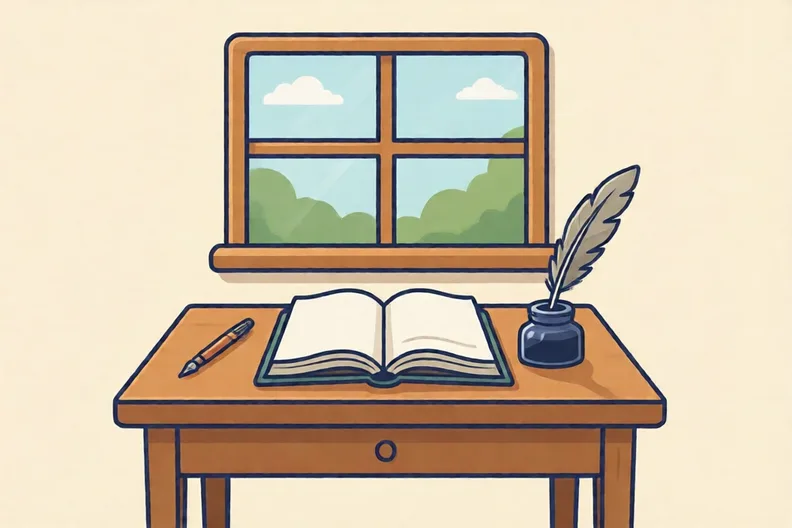
A wooden desk with an open book, a quill and an ink pot by a window
Watch me
ClaimEvidenceReasoning

Claim: The House of Wisdom helped scholars share ideas.

Evidence: Scholars there copied and translated many books.

Reasoning: So learning could spread further than one teacher's room.

Now you
  1. 1.

    Which sentence gives evidence about early Baghdad that a reader could check in a book? Circle one.

    FeelingEvidenceArgument
    I think the House of Wisdom was brilliant.Scholars gathered books from many places to compare ideas.Learning in Baghdad was the best and most fun thing ever.Sana loves reading about libraries.

C Your turn7 min

Join each feature to an example. Then work through the rows.

  1. 1.

    Join each feature to its example with a line.

    FeatureExample
    Fronted adverbialParenthesis in bracketsFact or statisticComplex sentence
    Meanwhile, scholars translated Greek texts.Arabic was the main language of learning across the empire.Libraries (which held many books) drew scholars from afar.Although the city was busy, students still studied late.
  2. 2.

    Sort these sentences into the two columns.

    FeelingEvidenceArgument
    I love reading about the Golden Age.Translations spread Greek ideas widely.Baghdad was the most exciting city ever.Hospitals trained doctors, aiding care.
    OpinionArgument
  3. 3.

    Number the parts of an essay in the order they come, 1 to 4.

    1. The conclusion restates the argument.
    2. The title is a question or statement.
    3. The sections give evidence for each point.
    4. The introduction states the argument.
  4. 4.

    Write one sentence about the House of Wisdom that puts extra information in brackets. Check the sentence still makes sense without the brackets.

    Main sentence(extra detail)Full stop

Say it out loud: What changed from one row to the next, and what did that change do to the writing?

D Spot the mistake3 min
Tall wooden bookshelves filled with closed books on a plain background
Ali says: “An essay is the place to share my own opinions, so I will write that the libraries were the best thing ever.”
  1. 1.

    Why is Ali wrong? Write one sentence.

E Think deeper4 min

  1. 1.

    Make up an essay question about early Islamic civilisation. Then write two arguments that could answer it. Each argument needs one reason. Read it to your grown-up.

    QuestionArgument oneArgument two

How did it feel?1 min

I can do it Nearly Not yet
StudyDen · Year 6 · English · Early Islamic civilisation: essay writingAnswers are on the grown-up page

For the grown-up

Features of an essay · 2 minutes to read

Answers, and what a wrong one tells you

A

1. Inside the library, the scribes copied books. Commas after an opening phrase come before the main clause, not inside it. Ask your child to read the sentence aloud and pause where the comma goes.

2. were your child may have read 'scribes' as one person. Ask how many scribes there are: more than one needs 'were'.

3. The book was copied by the scribe. If your child picks the first sentence, ask who is doing the action. In a passive sentence the subject receives the action.

B

1. Scholars gathered books from many places to compare ideas. your child may have picked the sentence that sounds most impressive. Ask: is this about the past, and could a reader check it in a book?

C

1. Fronted adverbial → Meanwhile, scholars translated Greek texts.; Parenthesis in brackets → Libraries (which held many books) drew scholars from afar.; Fact or statistic → Arabic was the main language of learning across the empire.; Complex sentence → Although the city was busy, students still studied late.

2. Opinion: I love reading about the Golden Age., Baghdad was the most exciting city ever. · Argument: Translations spread Greek ideas widely., Hospitals trained doctors, aiding care. If your child puts a feeling in the Argument column, ask: is there a reason or evidence someone could check?

3. 1 The title is a question or statement. · 2 The introduction states the argument. · 3 The sections give evidence for each point. · 4 The conclusion restates the argument. your child may have mixed up the introduction and the conclusion, as both state the argument. Ask: which one does the reader meet before any evidence?

4. Look for: One sentence with extra information inside brackets that still reads correctly when the brackets are removed.

D

1. Look for: Says an essay gives arguments supported by evidence and reasoning, not the writer's personal opinions. If your child only says 'it is not allowed', ask what an essay should contain instead: an argument, with evidence that a reader can check.

E

1. Look for: A question about early Islamic civilisation, followed by two arguments that each include a reason.

Words to use

Say“Is this a feeling, or a reason someone could check? What evidence would show it?”
Instead of“Tell them the essay is their chance to share what they feel about the topic.”

After the sheet

At home, ask your child to argue which breakfast is best for a busy morning, using one reason and one piece of evidence such as time or cost. Then ask for one sentence that is only a feeling, and compare the two.

Tick what your child got right in StudyDen. Anything missed comes back in a later Look back box, so there's no need to redo the sheet.

The rest of this unit

6 more sheets come with a StudyDen plan, in teaching order:

  1. Building a research timeline(with a plan)
  2. Planning an Essay Introduction(with a plan)
  3. Planning section one(with a plan)
  4. Joining Ideas in Section Two(with a plan)
  5. Ending the essay well(with a plan)
  6. Presenting with Confidence(with a plan)

Every Year 6 English worksheet

The worksheets plan opens a printable sheet for every lesson in Years 1 to 6, each with its answers on a separate page for you. It costs £6.99 a month or £59 a year for the whole family, with no free trial.

The full StudyDen plan adds the lessons themselves, marked as your child works, with the worksheets included. It is 7 days free, then £29.99 a month.

Both start with a free account; you choose the plan when you sign up.