← Year 6 English worksheets

Year 6 'Sherlock Holmes': descriptive and letter writing worksheet

“Victorian London and Holmes” is free to print, with no account. It is the first sheet in the Year 6 English unit “'Sherlock Holmes': descriptive and letter writing”, for children aged 10 to 11, and takes about 24 minutes.

Print it on A4. The child's pages come first; the answers, and what each wrong answer tells you, are on the grown-up page that follows. Weeks 20 to 23 of the year, 16 sheets in the unit.

Free sample · answers on the last page

Victorian London and Holmes

Name: ____________ · Date: ____________
Year 6 · English · about 24 minutes
Answers are on the grown-up page

Today I can understand the historical context of Sherlock Holmes.

A Look back3 min

  1. 1.

    Which word is a noun? “The fog hung over the river.”

    NounVerbPreposition
    hungfogover
  2. 2.

    Which tense is this sentence in? “Ali walked to school.”

    PastPresentFuture
    pastpresentfuture
  3. 3.

    Which word is the subject? “The dog barked loudly.”

    SubjectVerbAdverb
    barkeddogloudly

B Watch me, then you4 min

A reader asks when Queen Victoria's reign ended. Use the timeline to find the year.
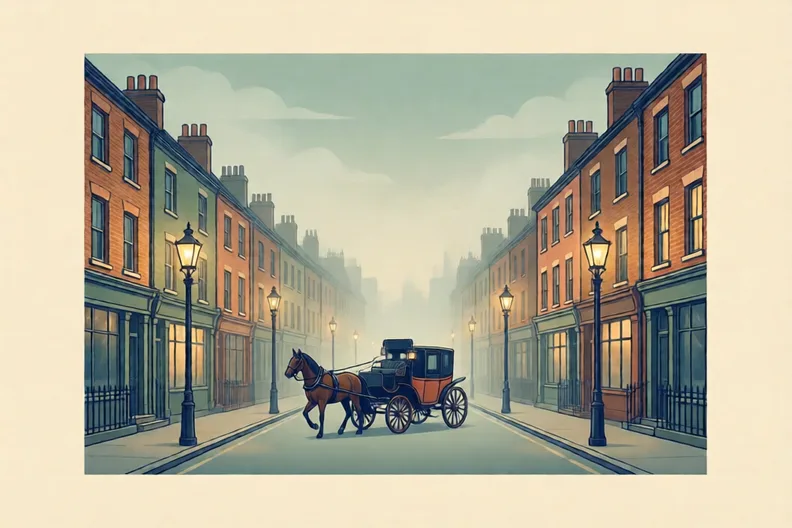
A foggy Victorian London street at dusk with gas lamps
Watch me
183018401850186018701880189019001910Victoria becomes queenDoyle is bornBlue CarbuncleVictoria dies

Victoria became queen in 1837.

She died in 1901, so her reign ended then.

The Victorian era was 1837 to 1901.

Now you
  1. 1.

    Arthur Conan Doyle, who wrote the Holmes stories, was born in .

    183018401850186018701880189019001910Victoria becomes queenDoyle is bornBlue CarbuncleVictoria dies

C Your turn8 min

Read each question and choose the answer that fits what you know about Victorian London and Holmes.

  1. 1.

    Most Holmes stories are told by Watson in the ___ perspective.

    Watson tells itReader followsStory unfolds
    first-personthird-personsecond-person
  2. 2.

    Holmes is a private detective, so he works for .

    Holmes investigatesMystery solved
    the policepeople who hire himthe government
  3. 3.

    A slum was .

    Big familiesOne small roomNo clean water
    a grand house in a rich streeta crowded area where poor people liveda quiet village in the country
  4. 4.

    Which is true of Victorian London?

    PovertyCrime
    It had no poor people.It had no crime.It was the largest city in the world.

Say it out loud: What did each question tell you about Holmes, Doyle or the city? Which clue helped you most?

D Spot the mistake3 min

Kit says: “The Blue Carbuncle came out after Queen Victoria died, so it is not a Victorian story.”
183018401850186018701880189019001910Victoria becomes queenBlue CarbuncleVictoria dies
  1. 1.

    Use the timeline to explain why Kit is wrong. Write one sentence.

E Think deeper4 min

  1. 1.

    Explain why Victorian readers might have felt safer with a detective like Holmes. Use one fact about London.

    Crime in the cityPolice struggleHolmes solves it

How did it feel?

I can do it Nearly Not yet
StudyDen · Year 6 · English · 'Sherlock Holmes': descriptive and letter writingAnswers are on the grown-up page

For the grown-up

Victorian London and Holmes · 2 minutes to read

Answers, and what a wrong one tells you

A

1. fog

2. past

3. dog

B

1. 1859 If your child writes 1837, they have found the year Victoria became queen. Ask: which label on the line is about Doyle?

C

1. first-person If your child picks third-person, ask: does Watson call himself 'I' or 'he'? Look for the word 'I' in the story.

2. people who hire him If your child picks the police, ask: does a private detective work for the police, or is he hired by someone else?

3. a crowded area where poor people lived If your child picks the grand house, ask: were slums for rich families or for very poor people? Talk about overcrowded housing.

4. It was the largest city in the world. If your child picks a claim about no poverty or no crime, remind them that the lesson says wealth and poverty sat side by side, and crime was common.

D

1. Look for: Says The Blue Carbuncle came out in 1892, before Victoria died in 1901, so the story belongs to the Victorian era. If your child agrees with Kit, ask them to point to Blue Carbuncle on the timeline, then to Victoria dies. Which comes first?

E

1. Look for: Mentions crime or danger in London and the idea that Holmes brings order or solves crimes the police find hard. If your child only says Holmes was clever, ask what problem in London he helped with.

Words to use

Say“What was London like when Holmes was written? Which fact surprised you most?”
Instead of“Just read the story and skip the history, it is only background.”

After the sheet

Take a walk round your street and ask what it might have looked like 150 years ago. Talk about what would have been different to see, hear and smell.

Tick what your child got right in StudyDen. Anything missed comes back in a later Look back box, so there's no need to redo the sheet.

The rest of this unit

15 more sheets come with a StudyDen plan, in teaching order:

  1. Who is telling the story?(with a plan)
  2. Detective story patterns(with a plan)
  3. Words for a Victorian street(with a plan)
  4. Planning a London setting(with a plan)
  5. Setting the scene in London(with a plan)
  6. Alleyway and study sentences(with a plan)
  7. Reading Holmes between the lines(with a plan)
  8. Persuasion in a Letter(with a plan)
  9. Finding the key points(with a plan)
  10. Persuading Holmes with care(with a plan)
  11. Opening a persuasive letter(with a plan)
  12. Colons that explain(with a plan)
  13. Adding asides with commas(with a plan)
  14. Closing the persuasive letter(with a plan)
  15. Editing your letter(with a plan)

Every Year 6 English worksheet

The worksheets plan opens a printable sheet for every lesson in Years 1 to 6, each with its answers on a separate page for you. It costs £6.99 a month or £59 a year for the whole family, with no free trial.

The full StudyDen plan adds the lessons themselves, marked as your child works, with the worksheets included. It is 7 days free, then £29.99 a month.

Both start with a free account; you choose the plan when you sign up.